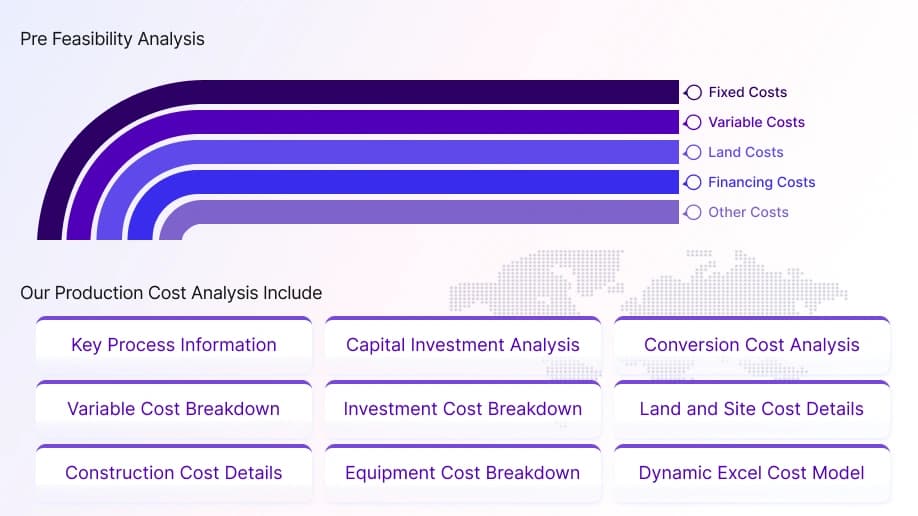
The report provides a detailed analysis essential for establishing a sodium alginate production plant. It encompasses all critical aspects necessary for sodium alginate production, including the cost of sodium alginate production, sodium alginate plant cost, sodium alginate production costs, and the overall sodium alginate production plant cost. Additionally, the study covers specific expenditures associated with setting up and operating a sodium alginate production plant. These encompass production processes, raw material requirements, utility requirements, infrastructure needs, machinery and technology requirements, manpower requirements, packaging requirements, transportation requirements, and more.
Sodium alginate is an organic polysaccharide obtained from brown seaweeds. It is widely utilized as a thickener, emulsifier, and stabilizer in the food, pharmaceutical, textile, and chemical industries. It is widely regarded as safe for human consumption, and regulatory bodies such as the FDA and EFSA have authorized it as a food additive. It can also be used in pharmaceutical and textile sectors for its gelling and binding qualities.
Sodium alginate is also used to make dental impressions and as a medication delivery bioadhesive. It is a non-toxic, food-grade thickener that can be used that can also be included in the formulations of dyes and paints. The compound can be used to produce printing inks that are further used for screen printing, etc.
The market for sodium alginate is strongly driven by its demand observed in the food, pharmaceutical, textile, and chemical industries. Its applications as a food-grade thickener and emulsifier for its gelling and binding ability in food products drive its demand in the food industry. Similarly, its usage for medical and pharmaceutical applications, including the production of bioadhesives to make dental impressions, fuels its demand in the pharmaceutical and healthcare industry. Moreover, its applications in the production of coatings, dyes, and inks for printing increase its demand on a large scale.
There are various factors that impact the procurement of sodium alginate in the global market. Factors including its demand in the food, medical, pharmaceutical, and chemical industries, along with its market prices, production cost, and supply, strongly impact the industrial sodium alginate procurement. The changes in its demand as an emulsifier, thickener, and binding agent in bioadhesives, food products, and coatings, along with the fluctuations observed in its market prices and distribution across various regions, directly influence its procurement around the world.
Raw Material for Sodium Alginate Production
According to the sodium alginate production plant project report, the key raw material for sodium alginate production includes sodium carbonate.
Production Process of Sodium Alginate
The extensive sodium alginate production cost report consists of the following major industrial production process:
- From Seaweed: The production process of sodium alginate is carried out by extraction from seaweed, specifically brown seaweeds (Phaeophyceae). The seaweed is treated in an alkaline solution using sodium carbonate. The alginic acid obtained from the weeds is then collected as precipitates and ion-exchanged to obtain sodium alginate at the end.
Sodium alginate is an organic polysaccharide with a chemical formula of (C6H7NaO6)n. The viscosity of sodium alginate solutions varies according to concentration, temperature, and pH. The viscosity of sodium alginate solutions can range from a few hundred to several thousand centipoises. It dries to produce a thin film, making it ideal as a coating material for a variety of purposes. It can be combined with a variety of components, including other polysaccharides, proteins, and synthetic polymers. It is stable throughout a wide temperature and pH range, making it suitable for a variety of applications that demand stable materials.