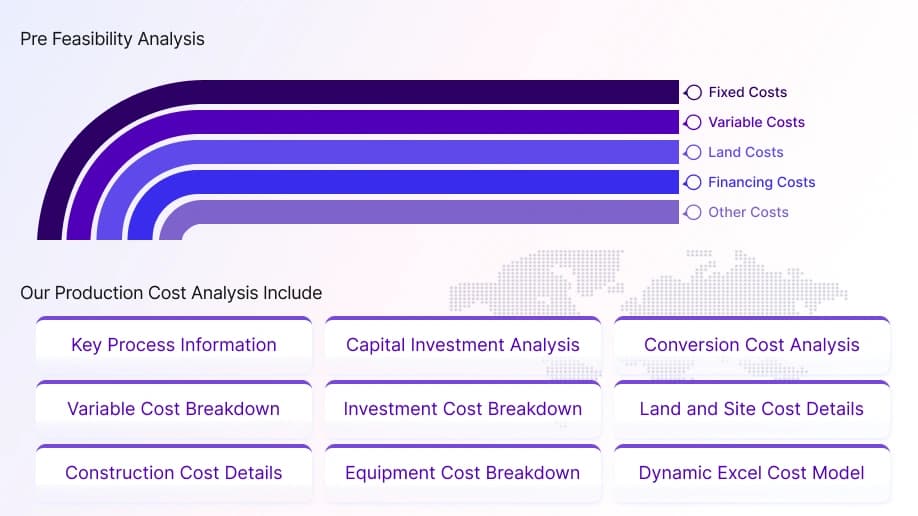
The report provides a detailed analysis essential for establishing a sodium chlorate production plant. It encompasses all critical aspects necessary for sodium chlorate production, including the cost of sodium chlorate production, sodium chlorate plant cost, sodium chlorate production costs, and the overall sodium chlorate production plant cost. Additionally, the study covers specific expenditures associated with setting up and operating a sodium chlorate production plant. These encompass production processes, raw material requirements, utility requirements, infrastructure needs, machinery and technology requirements, manpower requirements, packaging requirements, transportation requirements, and more.
Sodium chlorate is an inorganic compound that is used to make a wide range of products, including herbicides, matches, colors, dyes, inks, cosmetics, explosives, pharmaceuticals, beautifiers, pharmaceuticals, paper, calfskin, defoliants, paper as a dying mash, metal treatment, vanadium mining, and leather. In the production sector, it is employed for making fertilizers, matches, dyes, and explosives. It is also used as an oxidizing agent to bleach paper and as an herbicide. In the medical field, it is used to make various kinds of drugs.
The market demand for sodium chlorate is being driven by the expansion of the pharmaceutical, cosmetics, leather, and pulp & paper industries, as it is widely used to manufacture various pharmaceutical drugs, skin exfoliants, tanning & dyeing leather products, and pulp bleaching agent, respectively. Moreover, this compound is also used utilized in the manufacture of herbicides and explosives which further adds great value to this commodity among explosives and agriculture industries. Additionally, the availability and cost of production of sodium chlorate's feedstock (sodium chloride), sodium chlorate market prices, environmental regulations & safety concerns, storage, handling, distribution (including trading and shipping), logistics, etc., are some of the elements that influence an industrial sodium chlorate procurement.
Raw Material for Sodium Chlorate Production
According to the Sodium Chlorate production plant project report, the major raw materials for Sodium Chlorate production include Sodium Chloride.
Production Process of Sodium Chlorate
The extensive Sodium chlorate production cost report consists of this major industrial production process:
- Production from Sodium Chloride: In this process sodium chlorate is produced from sodium chloride by a typical electrolysis process. Firstly, to get rid of contaminants, salt must be dissolved and then purified. The chlorate electrolyte dissolves the purified salt, allowing it to enter the electrolyte circulation. As the electrolyte enters the electrolysis cells, water is reduced on the cathodes and chloride ions are oxidized on the anodes to produce hydrogen gas. An alkaline scrubber is used to remove chlorine from the gas coming from the electrolytic cells and reactor tanks. A slurry of crystallized sodium chlorate comes out of the vacuum crystallizer. Thus, sodium chlorate is formed.
Sodium Chlorate (NaClO3) is an inorganic sodium salt in which chlorate is the counter-ion. It's a powerful oxidising agent commercially made through the electrolysis of sodium chloride solutions.
It looks like a pale yellow to white crystalline solid with a cubic crystal structure that has no odour. It is soluble in water and heavier than it, sinking and dissolving at a fast rate. It has a solubility in a few organic solvents like glycerol and methanol and has slight solubility in acetone. It is not flammable, but any contact with wood, organic matter, sulfur, sulfuric acid, ammonium salts, various metals, and other chemicals might lead to fires or explosions. It has a molar mass of 106.44 g/mol and a density of 2.5 g/cm³. Its respective boiling and melting points are 300–400 °C and 248–261 °C.