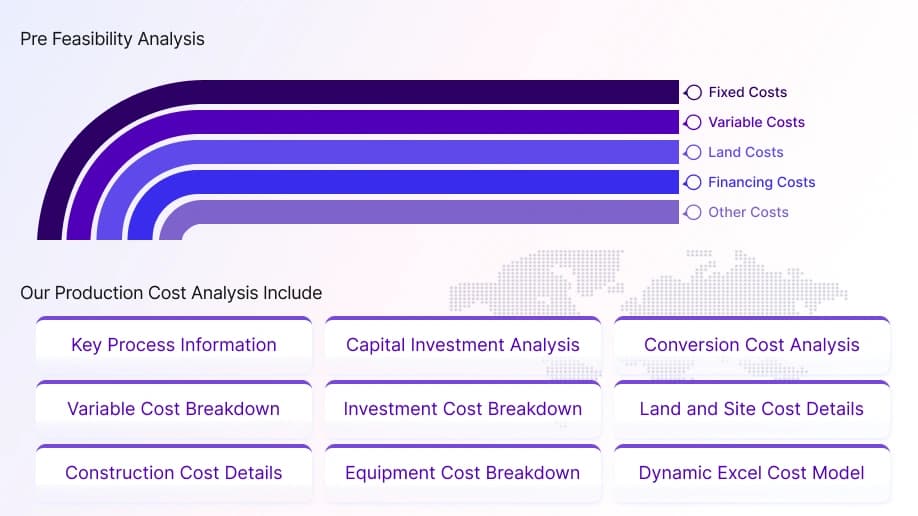
The report provides a detailed analysis essential for establishing a Styrene Butadiene Rubber production plant. It encompasses all critical aspects necessary for Styrene Butadiene Rubber production, including the cost of Styrene Butadiene Rubber production, Styrene Butadiene Rubber plant cost, Styrene Butadiene Rubber production costs, and the overall Styrene Butadiene Rubber production plant cost. Additionally, the study covers specific expenditures associated with setting up and operating a Styrene Butadiene Rubber production plant. These encompass production processes, raw material requirements, utility requirements, infrastructure needs, machinery and technology requirements, manpower requirements, packaging requirements, transportation requirements, and more.
Styrene Butadiene Rubber (SBR) is a synthetic rubber mainly used in tire production (as an abrasion-resistant replacement for natural rubber) for vehicles like trucks and cars (owing to its high heat resistance). It is employed in various industrial processes such as belting, hoses, gaskets, wire insulation and cabling, roll coverings, haul-off pads, seals, abrasion resistance, and metal adhesion. Commercially, it is used in the form of polymers in many applications like shoe soles, molded rubber goods, etc. It also finds application in the production of pressure-sensitive adhesives and tufted carpet bonding. In addition, it is employed in many other products like labels, tapes, and graphics. Also, cloth-inserted Styrene Butadiene Rubber is mainly used for applications related to mechanical fastening and flanged gaskets (its durability makes the rubber ideal for air, hot water, low-pressure steam, and hydraulic services).
The market for Styrene Butadiene Rubber (SBR) is driven by its usage to manufacture lightweight, durable, and fuel-efficient tires, which elevates its demand in the automotive industry. Its utilization in various products, such as waterproofing membranes, adhesives, and sealants, amplifies its demand in the construction industry. The rising shift towards synthetic rubbers due to their properties, such as consistent quality, and superior performance characteristics, such as abrasion resistance and durability, boost its demand even more.
Its usage to produce durable and flexible shoe soles fuels its demand in the footwear industry. Overall, industrial Styrene Butadiene Rubber (SBR) procurement is influenced by its application in various industries such as automotive, construction, rubber, and footwear industries, the availability of its raw materials (styrene and butadiene), the cost of its raw materials, the rising shift towards synthetic rubbers, sustainability initiatives, and technological advancements.
Raw Material for Styrene Butadiene Rubber Production
According to the Styrene Butadiene Rubber production plant project report, the key raw materials used in the production of Styrene Butadiene Rubber include styrene-butadiene.
Production Process of Styrene Butadiene Rubber
The extensive Styrene Butadiene Rubber production cost report consists of the following major industrial production processes:
- Production via Solution Process: The production process of Styrene Butadiene Rubber occurs via the continuous solution process. In this process, styrene and butadiene undergo anionic copolymerization continuously in two cascade-stirred tank reactors and the presence of cyclohexane as the solvent. In the next step, the polymer solution is steam-stripped for solvent removal. Finally, the crumb slurry is subjected to drying to produce SBR and sent to the packaging section.
- Production via Cold Emulsion Polymerisation Process: The production process of Styrene Butadiene Rubber (SBR) occurs through the cold emulsion polymerization process. In this process, an emulsion made of water, styrene, and butadiene monomers, at a temperature in the range of 5°C and 10°C, is polymerized to form a latex, which is then solidified to produce Styrene-Butadiene Rubber.
Styrene Butadiene Rubber (SBR) is a general-purpose synthetic rubber made from a styrene and butadiene copolymer. It's the highest volume general-purpose synthetic rubber with a wide application range. SBR offers many properties, such as resistance towards cracks, abrasion, ozone, organic acid, water, chemical, alcohol, ketone, and aldehydes; great impact strength and moderate tensile strength; good resilience, high tensile strength; excellent low-temperature properties, etc. It has a styrene content ranging between 10-25%, which leads to great wearing and bonding properties.