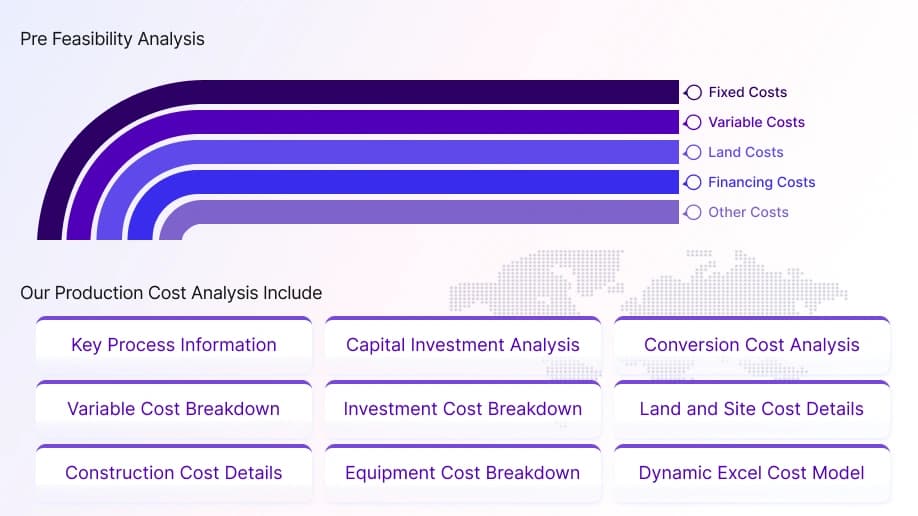
The report provides a detailed analysis essential for establishing a sulfuric acid production plant. It encompasses all critical aspects necessary for sulfuric acid production, including the cost of sulfuric acid production, sulfuric acid plant cost, sulfuric acid production costs, and the overall sulfuric acid production plant cost. Additionally, the study covers specific expenditures associated with setting up and operating a sulfuric acid production plant. These encompass production processes, raw material requirements, utility requirements, infrastructure needs, machinery and technology requirements, manpower requirements, packaging requirements, transportation requirements, and more.
Sulphuric acid is a mineral acid with strong acidic nature which is widely used in metallurgical and petroleum refining processes. It also finds its application in pharmaceutical, fertilizer, dye, detergent, explosive, acid, inorganic salt, and pigment industries. Due to its use in lead-acid storage batteries as an electrolyte, the market for sulfuric acid is growing globally. It is mostly used in fertilisers like ammonium sulphate and superphosphate of lime.
It is used to make chemicals like sulphate salts, hydrochloric acid, and nitric acid. It is employed in the processing of metals for tasks including pickling (cleaning) iron and plating steel prior to tin or zinc treatment. In addition, it is employed in the manufacture of paper, laboratory testing, and rayon textile production. The use of acid has many applications, which help to support the world economy.
The chemical sulfuric acid has a wide range of applications and is utilized as a raw ingredient in many different industries. The primary driver of the sulfuric acid market is the growing demand for this commodity, as an essential component used in the production of a wide range of chemicals and phosphate fertilizers, which increases its demand for the chemical production and fertilizer industry. Additionally, it is also used in the production of certain pharmaceutical products and in petroleum refining processes which add to its market expansion in the respective sector.
Furthermore, the availability and cost of production of sulfuric acid’s raw materials which include (sulfur dioxide, hydrogen peroxide, sulfur, etc), sulfuric acid market prices, storage and handling requirements, transportation and logistics, quality and purity of sulphuric acid, environmental impact and sustainability practices, etc. The global procurement of this commodity is greatly influenced by its necessity as a key component for the fertilizer, petroleum, chemical, and pharmaceutical industries.
Raw Material for Sulfuric Acid Production
According to the Sulfuric Acid production plant project report, the major raw materials for Sulfuric Acid production include Sulfur Dioxide-Hydrogen Peroxide; Sulfur; Spent Acid; Iron Pyrite Gas; Hydrogen Sulphide.
Production Process of Sulfuric Acid
The extensive Sulfuric acid production cost report consists of this major industrial production process:
- Production from Tail Gas Using H2O2 Abatement: The process involves the conversion of sulphur dioxide into sulphuric acid by exposing it into an aqueous scrubbing solution which contains sulfuric acid, hydrogen peroxide, and/or peroxy acids of sulfur. The reaction takes place in a gas liquid apparatus, where the oxidation of sulphuric oxide to sulphuric acid is facilitated by the presence of hydrogen peroxide or peroxy acids. This process results in the formation of sulphuric acid.
- Production from Sulphur via Single Contact Process: The process begins with burning sulfur which releases sulfur dioxide, which is then transformed into sulfur trioxide. By absorption in a single column with a recirculating sulfuric acid solution in water, sulfur trioxide is converted to sulfuric acid. When it comes to production sulfuric acid, the single contact method is efficient and economical.
- Production from Spent Acid via Double Contact: This process involves a double-contact double absorption (DC/DA) technique which is used to produce sulfur dioxide by breaking down the wasted acid in a furnace. Further sulphur dioxide containing gas is purified and undergoes the same technique to produce sulfuric acid as the resultant.
- Production from Iron Pyrite Gases: In this process, iron pyrite gas is treated and then, sulfur dioxide contained in the gas is converted to sulfur trioxide, which on double-contact double absorption generates sulphuric acid.
- Production from H2S via Wet Sulphuric Acid Process: This process produces sulfur dioxide and water by burning the hydrogen sulfide present in the feed gas. After turning sulfur dioxide into sulfur trioxide, the latter is cooled to a point at which it reacts with water in the gas phase to produce sulfuric acid.
Sulphuric acid is a popular mineral acid that is composed of sulphur, oxygen, and hydrogen. It is generated in highly exothermic processes and rapidly absorbs atmospheric water vapour. The acid's poisonous nature has bad effects on the eyes, skin, teeth, and lungs. It can be used in a variety of ways in the chemical industry, notably as an electrolyte for lead-acid batteries. Gases from iron pyrite are used to extract sulfuric acid. In this procedure, iron pyrite gas is handled, and the sulphur dioxide in the gas is changed into sulphur trioxide, which, after two contacts and two absorptions, yields sulphuric acid.
Sulphuric acid has the chemical formula H2SO4 and a molar mass of 98.079 g/mol. It has a melting point of 10 °C and a boiling point of 337 °C, respectively. It has a density of 1.83 g/cm3. It has no colour or smell and seems to be a viscous liquid. It is a very potent oxidising agent and is soluble in water. It has a specific gravity of 1.84 at 298 K.