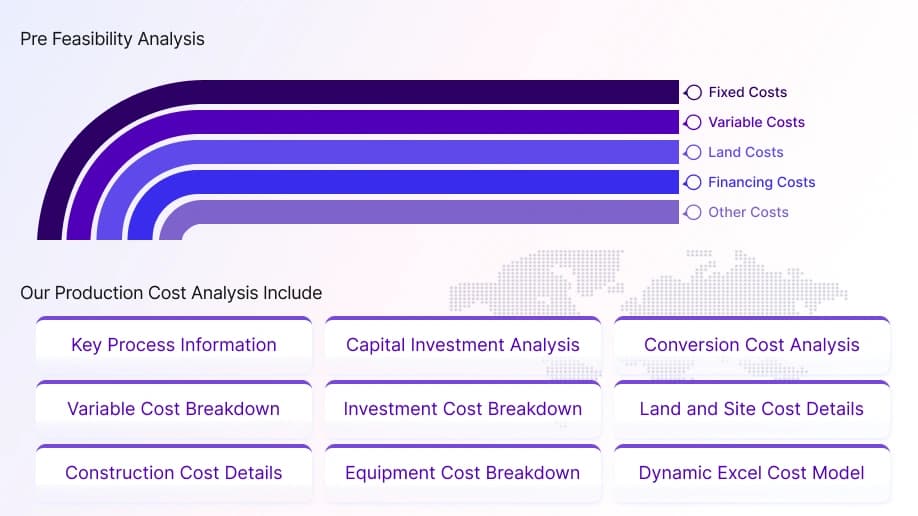
The report provides a detailed analysis essential for establishing a Terazosin production plant. It encompasses all critical aspects necessary for Terazosin production, including the cost of Terazosin production, Terazosin plant cost, Terazosin production costs, and the overall Terazosin production plant cost. Additionally, the study covers specific expenditures associated with setting up and operating a Terazosin production plant. These encompass production processes, raw material requirements, utility requirements, infrastructure needs, machinery and technology requirements, manpower requirements, packaging requirements, transportation requirements, and more.
Terazosin is a drug that is a quinazoline derivative and is used in various medical disorders. It is used in benign prostatic hyperplasia (BPH) to relax prostate muscles and the opening of the bladder, which may increase the flow of urine and decrease urinary symptoms associated with BPH. It is utilized in hypertension for relaxing muscles in the blood vessels and making them more open, thus, lowering the blood pressure.
Terazosin is used for its ability to allow the passage of kidney stones by relaxing the smooth muscle in the ureter. It helps in reducing symptoms of chronic prostatitis and chronic pelvic pain syndrome, as well as in reducing nightmares associated with PTSD. It works as an antihidrotic agent in patients experiencing excessive sweating because of the use of serotonin reuptake inhibitors. It can be used in combination with other antihypertensive agents to enhance blood pressure control.
The market of Terazosin is driven by several key factors. Its use in treating benign prostatic hyperplasia by relaxing prostate muscles and the opening of the bladder contributes to its growing demand. Its utilization in relaxing muscles in blood vessels in the case of hypertension makes it a popular drug in the clinical field. Its use for easy passage of kidney stones by easing smooth muscle in the ureter, as well as its use in reducing symptoms of chronic prostatitis and chronic pelvic pain syndrome, makes it a sought-after product. Overall, industrial terazosin procurement is influenced by its usage in treating benign prostatic hyperplasia, hypertension, kidney stone passage, chronic prostatitis, pelvic pain syndrome, etc., along with improved awareness and diagnosis rates, favorable reimbursement policies, and the availability of generics.
Raw Material for Terazosin Production
According to the Terazosin production plant project report, the key raw materials used in the production of Terazosin include (2-Chloro-4-Amino-6,7-Dimethoxyquinazoline)-Polar Organic Solvent-((Tetrahydrofuran-2-carbonyl) piperazine)-Hydrochloric acid.
Production Process of Terazosin
The detailed Terazosin production cost report consists of the following major industrial production process:
- From 2-Chloro-4-Amino-6,7-Dimethoxyquinazoline, Polar Organic Solvent, (Tetrahydrofuran-2-Carbonyl) Piperazine, and Hydrochloric acid: The production process for Terazosin involves several key steps. First, 2-chloro-4-amino-6,7-dimethoxyquinazoline is reacted with (Tetrahydrofuran-2-carbonyl)piperazine in the presence of polar organic solvent. The reaction mixture is heated, and after reaction, the mixture is cooled to room temperature. The crystalline terazosin hydrochloride is filtered and purified using recrystallization to obtain pure terazosin hydrochloride.
Terazosin is a white crystalline powder. Its molecular formula is C19H25N5O4, and it has a molecular weight of around 387.43 g/mol. It is lightly soluble in water but shows good solubility in DMSO. Its melting point is in the range 272.6–274°C. It has a piperazine ring and a quinazoline core with methoxy and carbonyl substituents. Its bioavailability is about 90%, with peak plasma concentrations occurring 1-2 hours post-administration. It is stored at room temperature, away from moisture and direct sunlight. All these physical and chemical properties contribute to its activity for treating various problems.