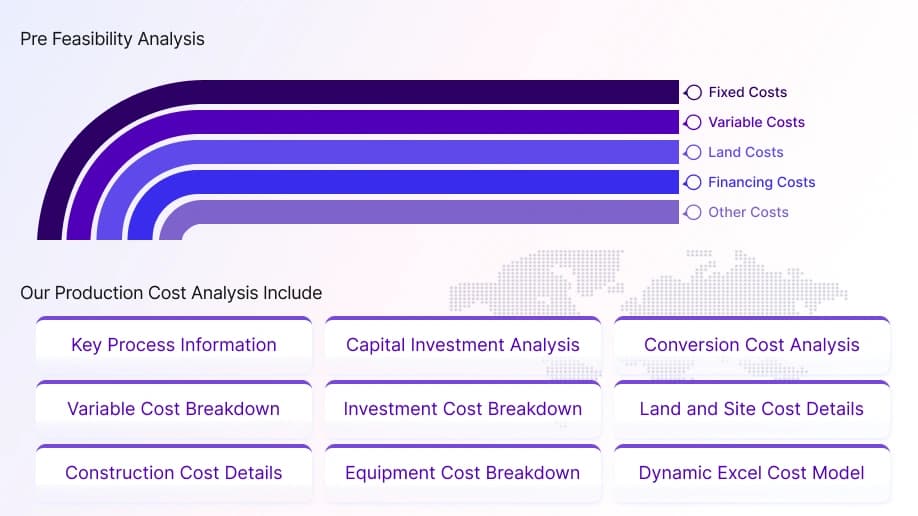
The report provides a detailed analysis essential for establishing a Tin production plant. It encompasses all critical aspects necessary for Tin production, including the cost of Tin production, Tin plant cost, Tin production costs, and the overall Tin production plant cost. Additionally, the study covers specific expenditures associated with setting up and operating a Tin production plant. These encompass production processes, raw material requirements, utility requirements, infrastructure needs, machinery and technology requirements, manpower requirements, packaging requirements, transportation requirements, and more.
Tin is a chemical element mainly used to coat, polish, and plate steel. Tin is also used to make cans, which are then used to make food containers, bearings, and solder. It is also utilized for soldering steel. Tin is also an important component in alloys such as bronze, utilized in batteries (especially lead-acid), and various chemical applications, such as stabilizers for PVC. The metal is also associated with goods such as sensors, glass, and ceramics. Its application in lithium-ion batteries is utilized in the electronics industry. It serves as an antifouling agent in the shipping industry and is used in construction materials for roofing and energy storage technologies. Additionally, it is used in some dental products as a type of stannous fluoride (SnF2).
The market for Tin is driven by its usage for soldering applications, which elevates its demand in the electronics industry. Its utilization in various vehicle components boosts its demand in the automotive industry. Its usage for packaging food items fuels its demand in the packaging industry. The rising shift towards sustainability and recycling also contributes to its market demand. Overall, industrial Tin procurement is influenced by its application in various industries such as electronics, automotive, packaging, and dental industries, the availability of its raw material (cassiterite), the cost of its raw material, the rising shift towards sustainability and recycling, environmental regulations, government policies, and investment opportunities.
Raw Material for Tin Production
According to the Tin production plant project report, the key raw material used in the production of Tin includes cassiterite.
Production Process of Tin
The extensive Tin production cost report consists of the following major industrial production process:
- Production through the mining of Cassiterite: The production process of Tin starts with extracting or mining cassiterite (a tin oxide), followed by its refining as the ore containing the Tin also has a lot of impurities and a mixture of other elements such as gravel, silica, carbon, salt, fuel, limestone, or coal. The raw ore is concentrated using methods such as gravity separation. The concentrated ore undergoes smelting, where carbon-based fuels reduce the tin oxide to metallic Tin. The crude Tin is refined using electrolysis or other methods to produce pure Tin.
Tin is a chemical element which belongs to the carbon family. It is produced by the mining of cassiterite ore. It is silvery-white with a tint of blue in appearance. The atomic number of Tin is 50, and its atomic weight is 118.69 U. The electronic configuration of Tin is [Kr]4d105s25p2 n, and its oxidation states are +2 and +4. The melting point and boiling point of Tin are 231.97 °C (449.54 °F) and 2,270 °C (4,100 °F), respectively. It is non-toxic, malleable, and ductile.