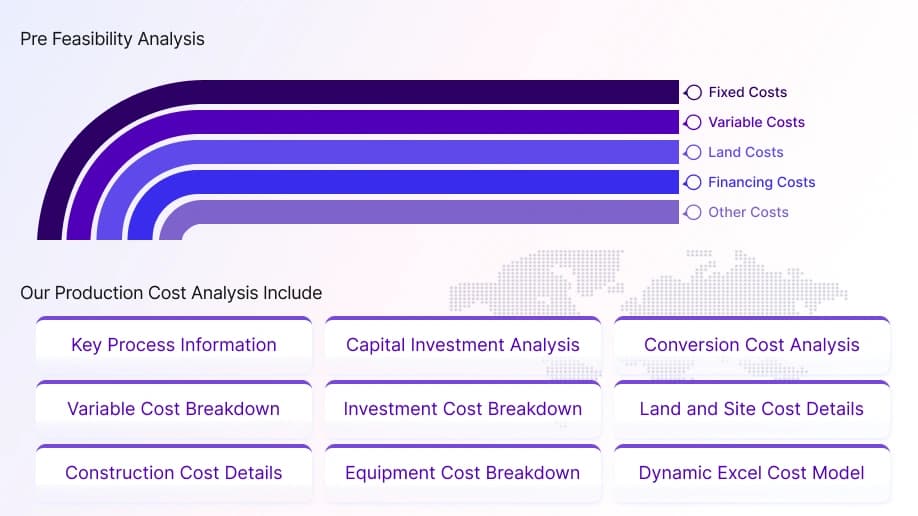
The report provides a detailed analysis essential for establishing a Trifluralin production plant. It encompasses all critical aspects necessary for Trifluralin production, including the cost of Trifluralin production, Trifluralin plant cost, Trifluralin production costs, and the overall Trifluralin production plant cost. Additionally, the study covers specific expenditures associated with setting up and operating a Trifluralin production plant. These encompass production processes, raw material requirements, utility requirements, infrastructure needs, machinery and technology requirements, manpower requirements, packaging requirements, transportation requirements, and more.
Trifluralin is a pre-emergence herbicide that is used in several agricultural settings. It is used in cereals such as wheat, barley, etc., as well as in oil seeds like canola and peanuts. It is utilized in vegetables like lettuce, and tomatoes and fruit crops like citrus fruits and strawberries. It is usually in emulsifiable concentrate or granule formulations and can either be applied before planting or topically onto the soil after planting. It also has uses in turf, ornamentals, forestry, aquatic sites, and residential/industrial areas aimed at controlling annual weeds. The pre-emergent activity makes it a valuable tool for the management of weed establishment in many different settings. It is very effective in managing weeds, and it has a long soil half-life with a very low leaching rate. However, it is important to carefully manage its usage to mitigate agricultural productivity against environmental safety.
The market for Trifluralin is driven by several factors. First of all, the continued growth in global demand for food production requires effective weed management that contributes to its demand. Its usage across many agricultural systems and its compatibility with integrated pest management strategies make it a popular product among farmers. The development of new application methods and affordability, when compared with alternative weed management methods, makes it a sought-after product. Overall, industrial trifluralin procurement is influenced by its versatility across various crops, integration into pest management strategies, technological advancements, favorable regulatory status, environmental considerations, and its cost-effectiveness in weed control.
Raw Material for Trifluralin Production
According to the Trifluralin production plant project report, the key raw materials used in the production of Trifluralin include 2,6-Dinitrotoluene-Sodium Nitrite-Hydrochloric Acid-Chlorine Gas-Diethylamine.
Production Process of Trifluralin
The extensive Trifluralin production cost report consists of the following major industrial production process:
- From 2,6-Dinitrotoluene, Sodium Nitrite, Hydrochloric Acid, Chlorine Gas, and Diethylamine: The industrial production process for Trifluralin involves several steps. First, 2,6-dinitrotoluene goes through nitration, forming an intermediate compound. This intermediate is reduced in the presence of a metal catalyst forming triaminotoluene. After this, the triaminotoluene is reacted with sodium nitrite and hydrochloric, forming trichlorotoluene. Then, this compound is chlorinated, followed by its reaction with diethylamine, forming Trifluralin.
Trifluralin is a yellow-orange crystalline solid. Its molecular formula is C13H16F3N3O4, and it has a molecular mass of Trifluralin 335.283 g/mol. It has a melting point of around 48.5-49 °C, and its boiling point is around 139-140 °C. It has low solubility in water, making it a hydrophobic compound. Its vapor pressure value is around 1.02 x 10^-4 mm Hg. It is stable for hydrolysis but can decompose under UV light. It has a long half-life of around 180 days in soil and is resistant to leaching. All these physical and chemical properties contribute to its applications as herbicides.