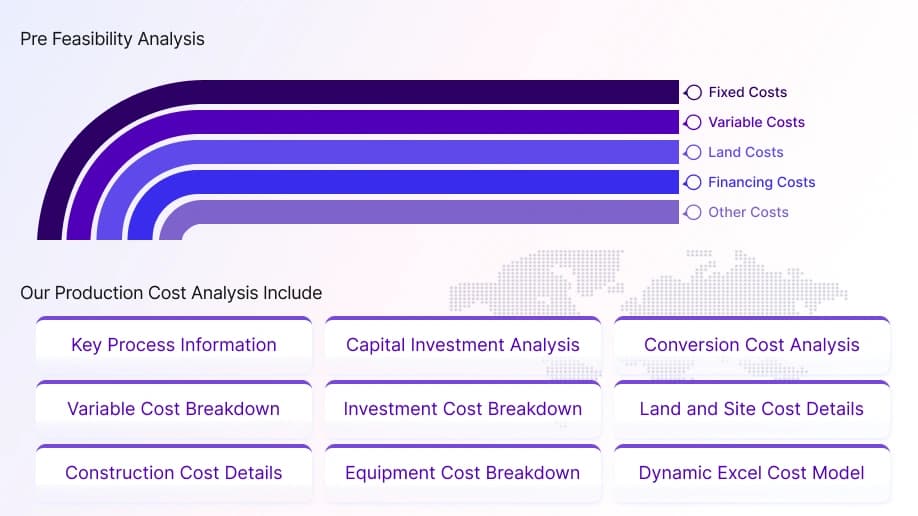
The report provides a detailed analysis essential for establishing a Vanadyl Acetylacetonate production plant. It encompasses all critical aspects necessary for Vanadyl Acetylacetonate production, including the cost of Vanadyl Acetylacetonate production, Vanadyl Acetylacetonate plant cost, Vanadyl Acetylacetonate production costs, and the overall Vanadyl Acetylacetonate production plant cost. Additionally, the study covers specific expenditures associated with setting up and operating a Vanadyl Acetylacetonate production plant. These encompass production processes, raw material requirements, utility requirements, infrastructure needs, machinery and technology requirements, manpower requirements, packaging requirements, transportation requirements, and more.
Vanadyl acetylacetonate is a vanadium coordination compound that has applications in chemistry and materials science. It is used as a catalyst in the epoxidation of olefins in the presence of other reagents like tert-butyl hydroperoxide. It is utilized in asymmetric oxidation of disulfides, forming chiral molecules. It is employed as a catalyst in the Mannich reaction to form carbon-nitrogen bonds. It is also used in the sulfoxidation of alkanes to improve the efficiency of these reactions. Vanadyl acetylacetonate works as a precursor for the preparation of vanadium dioxide thin films because of its thermal and optical properties. It finds its application in medicinal chemistry for its antidiabetic and anticancer activities. It is also utilized as a paint dryer and pigment in various formulations for improving the properties of coatings and inks.
The market of vanadyl acetylacetonate is driven by its distinct applications in various fields. Its use as a catalyst in the epoxidation of olefins, asymmetric oxidation of disulfides, Mannich reactions, and sulfoxidation of alkanes contributes to its growing demand in organic synthesis. Its use in material science as a precursor for vanadium dioxide thin films makes it a popular product. Its utilisation as a pigment and paint dryer for improving the properties and drying times of coatings and inks makes it a sought-after product. Also, its use in medicinal chemistry, mainly for its antidiabetic and anticancer activities, further contributes to its demand. Overall, industrial vanadyl acetylacetonate procurement is influenced by its use as a catalyst, advancements in material science, and the growing focus on vanadium-based compounds.
Raw Material for Vanadyl Acetylacetonate Production
According to the Vanadyl Acetylacetonate production plant project report, the key raw materials used in the production of Vanadyl Acetylacetonate include Vanadyl Sulfate-Acetylacetone.
Production Process of Vanadyl Acetylacetonate
The extensive Vanadyl Acetylacetonate production cost report consists of the following major industrial production process:
- From Vanadyl Sulfate and Acetylacetone: The production of Vanadyl Acetylacetonate consists of several steps. First, vanadyl sulfate is dissolved in the solvent; after that, acetylacetone is added to the solution. Then, the reaction leads to the formation of Vanadyl Acetylacetonate. Finally, the product is purified by crystallization or filtration to obtain pure Vanadyl Acetylacetonate.
Vanadyl Acetylacetonate is a deep blue solid with an approximate density of 1.4 g/cm³. It has a molecular formula of C10H14O5V with a molecular weight of 265.16 g/mol. It is soluble in organic solvents, especially methanol, ethanol, and chloroform, but almost insoluble in water. It acts as a catalyst in different organic reactions; it is non-flammable and not explosive. It is quite toxic and an irritant by contact and also if swallowed. These physical and chemical properties make it useful in both organic synthesis and materials science.