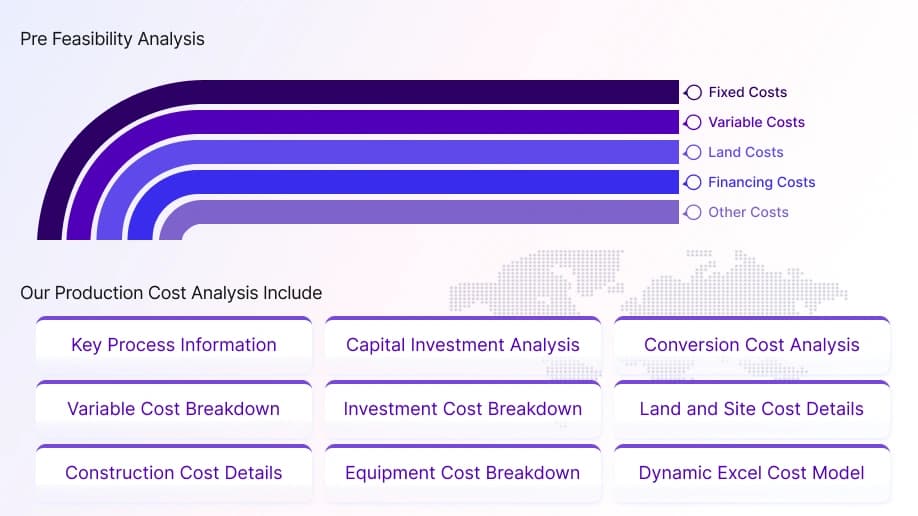
The report provides a detailed analysis essential for establishing a xylose production plant. It encompasses all critical aspects necessary for xylose production, including the cost of xylose production, xylose plant cost, xylose production costs, and the overall xylose production plant cost. Additionally, the study covers specific expenditures associated with setting up and operating a xylose production plant. These encompass production processes, raw material requirements, utility requirements, infrastructure needs, machinery and technology requirements, manpower requirements, packaging requirements, transportation requirements, and more.
Xylose, also known as wood sugar, is a form of sugar that is isolated from wood and is widely used as a sweetener for diabetics and production fructose-rich corn syrup. It is mostly utilized as a sweetener in a wide variety of food and beverages that provide a mild and pleasant taste it. It is also incorporated in several sugar-free and low-calorie products, including baked goods, etc. Moreover, it also finds its application in production dietary supplements or in pharmaceutical preparations and enhancing drug delivery systems and bioavailability. It is also used as a dietary supplement in animal feed.
The market for xylose is majorly driven by its application as a flavoring agent and sweetener used in various food products, which increases its demand in the food & beverage industry. Its usage in the manufacture of several dietary products and as a nutrient supplement in animal feed, further promotes its demand in the processed food and animal feed industries.
Moreover, its application in the production of pharmaceutical preparations or dietary supplements amplifies its demand in the medical and pharmaceutical industries. Additionally, its use in enhancing drug delivery systems fuels its demand in the diagnostics, research, and biotechnology industries. Furthermore, several factors influence industrial xylose procurement, such as the source and purity, cost and pricing, regulatory compliance, quality standards, technological advancements, environmental considerations, sustainability practices, distribution (including trading and shipping), logistics, safety standards, etc.
Raw Material for Xylose Production
According to the Xylose production plant project report, the major raw material for Xylose production includes Corncob.
Production Process of Xylose
The extensive Xylose production cost report consists of the following industrial production process:
- Production from Corncob: This method utilizes the technology of steam explosion for producing xylose on a large scale. The process is initiated by the pre-impregnation of corncob with sulfuric acid at 80°C for 3 h, followed by crosscurrent extraction, decoloration, and ion-exchange, which finally results in the production of xylose in the form of crystals.
Xylose is a monosaccharide that consists of five carbon atoms and an aldehyde functional group. Xylose is a form of sugar that is obtained from wood. The chemical formula of the compound is C5H10O5, and its molecular weight is 150.13 g/mol. The melting point of D-xylose is 153-154 °C. It appears as a white crystalline solid, and its density is 1.525 g/cm3. Xylose is also known as wood sugar. It is obtained from a hemicellulosic fraction of lignocellulosic biomass. It is naturally found in some plants.