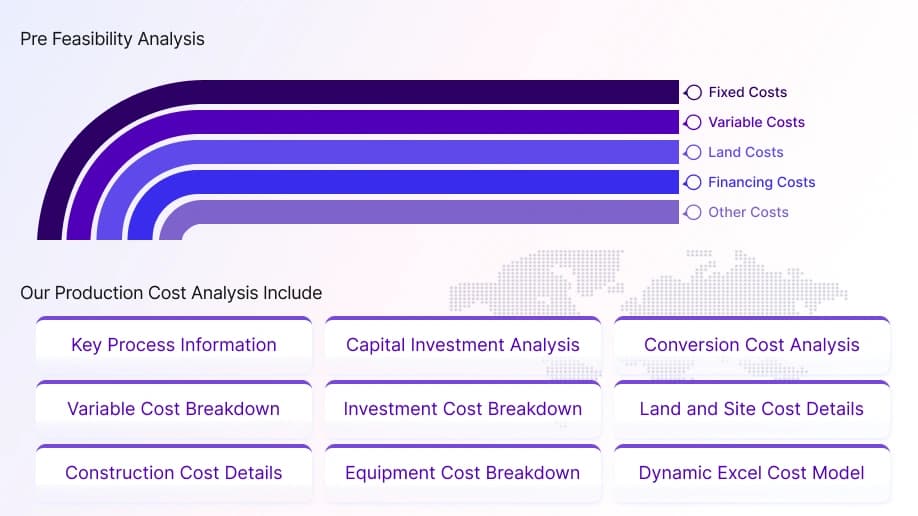
The report provides a detailed analysis essential for establishing a Yellow Phosphorus production plant. It encompasses all critical aspects necessary for Yellow Phosphorus production, including the cost of Yellow Phosphorus production, Yellow Phosphorus plant cost, Yellow Phosphorus production costs, and the overall Yellow Phosphorus production plant cost. Additionally, the study covers specific expenditures associated with setting up and operating a Yellow Phosphorus production plant. These encompass production processes, raw material requirements, utility requirements, infrastructure needs, machinery and technology requirements, manpower requirements, packaging requirements, transportation requirements, and more.
Yellow Phosphorus is a chemical element employed in the production of phosphoric acid. It is also used to manufacture phosphorous-based fertilizers such as diammonium phosphate (DAP). It is a versatile chemical element that also finds its applications in various products such as agricultural goods, lubricant additives, plastic stabilizers, fire retardants, surfactants, and metal extractants. Additionally, it is also utilized in detergents, water treatment, and metal surface treatment.
The market for Yellow Phosphorus is driven by its usage as an important ingredient in phosphate fertilizers that enhance soil fertility and crop yields, which elevates its demand in the agrochemical industry. Its utilization in various industrial applications, such as the production of chemicals, pharmaceuticals, and specialty materials, amplifies its market appeal. Its usage in detergents, water treatment, and metal surface treatment boosts its demand even more. Overall, industrial Yellow Phosphorus procurement is influenced by its application in the agrochemical, pharmaceutical, chemical, and household products industries, the availability of its raw materials (phosphorus ore, anthracite, and wollastonite), the cost of its raw materials, sustainability trends, and technological advancements.
Raw Material for Yellow Phosphorus Production
According to the Yellow Phosphorus production plant project report, the key raw materials used in the production of Yellow Phosphorus include phosphorus ore-anthracite-wollastonite.
Production Process of Yellow Phosphorus
The extensive Yellow Phosphorus production cost report consists of the following major industrial production process:
- Production from phosphorus ore: The production process of Yellow Phosphorus starts with washing and drying the phosphorus ore. In the next step, the ore is sent into an electric furnace where a redox reaction is carried out to produce a furnace gas, which is cooled, and Phosphorus is obtained via sedimentation. After the first sedimentation, crude Phosphorus is sent to a refining kettle. Secondary sedimentation occurs in the next step, followed by steam heating and clarifying the kettle to deposit pure Phosphorus. The pure Phosphorus is sent for tertiary sedimentation. Finally, solid-liquid separation takes place to obtain the Yellow Phosphorus.
Yellow Phosphorous is a chemical element and the most reactive form of phosphorus and is volatile in nature. It is produced via phosphate rock. The chemical formula of Yellow Phosphorous is P4, and its molecular weight is 123.895048 g/mol. The boiling point of Yellow Phosphorous is 277, and its melting point is 44.1. It is a yellow waxy solid, and it can be cut easily with a knife. The relative density of Yellow Phosphorous is 1.82 (20). It is insoluble in water but is soluble in liquid alkali, ether, chloroform, toluene, and carbon disulfide. It smells like garlic.