

Udeesha Tomar
AVP - Strategy and Solutions
Leading procurement research solutions across chemicals, materials, and food & beverages, with expertise in price forecasting and market analytics.

| Product | Region | Incoterm Basis | Price | Last Updated Month |
|---|---|---|---|---|
| 2-Ethylhexyl Acrylate | China | FOB | USD 1,470.39/MT | August 2026 |
| 2-Ethylhexyl Acrylate | India | CIF | USD 1,561.18/MT | August 2026 |
| 2-Ethylhexyl Acrylate | USA | CIF | USD 1,626.01/MT | August 2026 |
| 2-Ethylhexyl Acrylate | Germany | CIF | USD 1,583.98/MT | August 2026 |
| 2-Ethylhexyl Acrylate | Japan | CIF | USD 1,504.71/MT | August 2026 |
| 2-Ethylhexyl Acrylate | China | FOB | USD 1,457.55/MT | July 2026 |
| 2-Ethylhexyl Acrylate | India | CIF | USD 1,564.36/MT | July 2026 |
| 2-Ethylhexyl Acrylate | USA | CIF | USD 1,645.04/MT | July 2026 |
| 2-Ethylhexyl Acrylate | Germany | CIF | USD 1,591.18/MT | July 2026 |
| 2-Ethylhexyl Acrylate | Japan | CIF | USD 1,490.55/MT | July 2026 |
Stay updated with the latest 2-Ethylhexyl Acrylate prices, historical data, and tailored regional analysis
Asia
In China, 2-ethylhexyl acrylate averaged around 5,166 USD/MT (FOB) in June'26. India's CIF price was at roughly 5,254 USD/MT over the same month. Asian market conditions weakened during Q2 as softer 2-ethylhexanol costs reduced production pressure and downstream buyers resisted higher offers. Purchasing from coatings, pressure-sensitive adhesives and acrylic polymer producers remained largely need-based, keeping sellers under pressure to move inventories. Regional supply flexibility also improved after BASF commissioned a new 2-EHA storage tank in Merak, Indonesia, in May, complementing its existing supply network in Malaysia and China.
Europe
In Germany, prices settled near 4,335 USD/MT (CIF) during the last month of Q2'26. European 2-EHA conditions were initially supported by tight availability, higher propylene costs and disruptions linked to Middle Eastern logistics. The market subsequently softened as buyers completed their immediate requirements and expectations of additional Asian cargoes reduced purchasing urgency. Import uncertainty increased after the European Commission ordered registration of 2-EHA and butyl acrylate imports from China, Saudi Arabia, South Africa and the United States on May 20, 2026, allowing possible retroactive anti-dumping measures. Soft coatings and adhesives demand nevertheless restricted suppliers' ability to sustain stronger offers.
North America
During June'26, 2-ethylhexyl acrylate price averaged approximately 5,321 USD/MT (CIF) in USA. North American 2-EHA remained supported by elevated raw-material, energy and logistics costs during Q2. Producers attempted to pass higher operating costs through the supply chain, but soft underlying demand in the United States limited the extent of increases. Buyers in adhesives, coatings and construction-related applications maintained conservative inventories, balancing cost pressure with subdued consumption.
Analyst Insight
According to Procurement Resource, 2-EHA prices are expected to remain mixed, with softer Asian feedstock costs weighing on the market while energy, logistics and trade-policy risks continue to support Europe and North America.
Related Report
Need Latest 2-Ethylhexyl Acrylate Prices?
Get real-time price assessments, periodic trends, forecasts and price driver insights across key global markets.
Our Clients


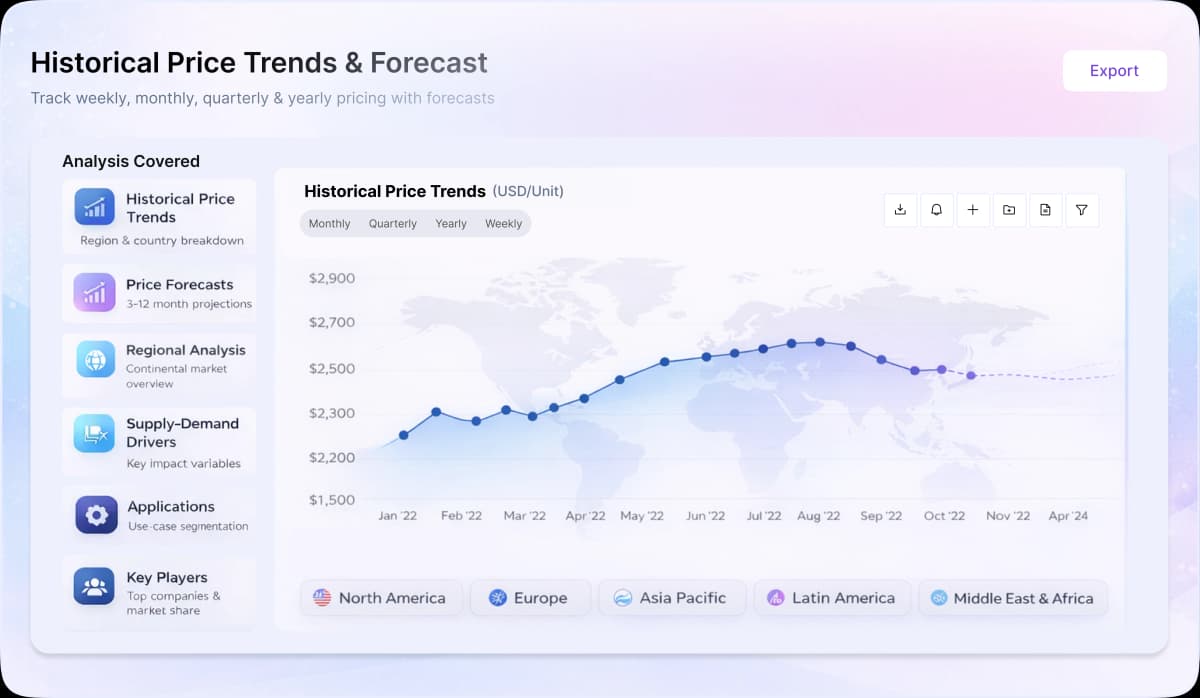
Turn price intelligence into action with the Procurement Resource Database. Log in or subscribe to unlock live price trends, historical charts, supplier databases, cost curves, and analyst-backed insights across chemicals, agriculture, energy, packaging, and more. Use these tools to benchmark your contracts, plan budgets with confidence, and stay ahead of market moves on every product you buy.
0
+Products
0
+Regions
0
+Subscriptions
Asia
During Q4'24, the 2-Ethylhexyl Acrylate (2-EHA) market in Asia demonstrated notable volatility. The quarter began with strong upward momentum, primarily driven by tight acrylic acid supply due to maintenance shutdowns at major facilities. Chinese manufacturers faced pressure as both key feedstocks - acrylic acid and ethylene - showed significant strength early in the quarter.
The market saw additional support from healthy demand in the coatings and adhesives sectors. However, by December, the pricing trend reversed as feedstock availability improved, particularly with increased ethylene imports from the US and the restart of several acrylic acid facilities in the region. Southeast Asian markets maintained relatively stable demand but experienced similar price fluctuations, albeit less pronounced.
Europe
European 2-EHA markets navigated through a challenging quarter with relatively stable pricing. The initial weeks saw modest upticks as producers attempted to maintain margins amid rising acrylic acid costs. However, these efforts were constrained by logistics challenges in receiving US ethylene shipments and subdued demand from downstream industries. The market faced additional pressure from competitive Asian imports, which limited producers' ability to implement significant price increases. The latter part of the quarter saw prices gradually soften as inventory levels remained comfortable and downstream demand stayed lukewarm, particularly in the construction and automotive sectors.
North America
The North American 2-EHA market showed distinct trends throughout Q4'24. The quarter started with firm pricing supported by stable domestic demand and elevated production costs. However, as the period progressed, the market faced downward pressure from abundant ethylene supply due to record US production levels. While acrylic acid costs remained relatively stable, the overall market dynamics led to margin pressure for producers. The region maintained steady production rates despite increasing competition from imports, but prices gradually declined through the quarter as supply remained ample against moderate demand.
The clear liquid 2-ethylhexyl acrylate has outstanding flexibility and diluting qualities. One of the ingredients of acrylic polymeric latex is 2-ethylhexyl acrylate. Pressure-sensitive adhesives can be made by polymerizing it with methyl methacrylate via free-radical solution polymerization. 2-ethylhexyl acrylate is a popular feedstock for chemical synthesis because it easily performs addition reactions with a wide spectrum of organic and inorganic chemicals.
C11H20O2
Paints and coatings, Adhesives and sealants, Plastics, Printing inks
2-Ethyl-1-hexyl acrylate, 2-Ethylhexyl 2-propenoate, Acrylic acid, 2-ethylhexyl ester, 2-ethylexyl acrylate
The Dow Chemical Company, BASF SE, Arkema Group
CurrencyUS$ (Data can also be provided in local currency)
Supplier Database AvailabilityYes
Customization ScopeThe report can be customized as per the requirements of the customer
Post-Sale Analyst Support360-degree analyst support after report delivery
Note: Our supplier search experts can assist your procurement teams in compiling and validating a list of suppliers indicating they have products, services, and capabilities that meet your company's needs.
Acrylic acid and 2-ethylhexanol are used in the industrial production of 2-ethylhexyl acrylate. The reaction, which is catalysed by sulfuric acid, takes place in batch reactors and is followed by a continuous distillation section.
Our Price Analysis Methodology
AVP - Strategy and Solutions
Leading procurement research solutions across chemicals, materials, and food & beverages, with expertise in price forecasting and market analytics.

Experience how Procurement Resource transforms raw material price data into clear, decision ready intelligence. Optimise your performance with reliable, expert market data and analysis. Schedule your demo today to experience a live walk-through where our experts will showcase interactive price charts, forecasted prices, and insights driving the prices for your key commodities, tailored to your workflows. Contact us now!
Our Team will be happy to assist you
We are just a text away
Still Need Help?
Unlock full access to Procurement Resource's price databases, interactive charts, and short-term forecasts for thousands of commodities. Elevate your sourcing decisions by comparing prices across regions, downloading historical data, and layering in analyst-backed insights, all with our flexible plans that scale as your portfolio grows.
Still have any Questions
Contact Us



Price Trend Dashboard - What's Included
Price trends across a diverse portfolio of categories and products, spanning board to niche chemicals
Coverage extendable to grade-specific chemicals based on procurement requirements
Regular price tracking supported by robust historical datasets
News, policy updates, and key market drivers impacting price movements
Short-term and long-term price outlooks and forecasts
Supply–demand dynamics and capacity-driven market analysis

Track prices, market movements, supply-demand dynamics, and industry developments across hundreds of commodities through a centralized intelligence platform built for informed procurement decisions.

Understand market fluctuations using analyst-backed forecasts, historical pricing patterns, and evolving industry trends to strengthen sourcing strategies and budget planning.

Leverage cost models, pricing benchmarks, and procurement insights to evaluate purchasing opportunities, improve negotiations, and enhance operational efficiency.
Access region-specific price trends, trade activities, capacity changes, and supply chain developments influencing commodity markets worldwide.