Udeesha Tomar
AVP - Strategy and Solutions
Leading procurement research solutions across chemicals, materials, and food & beverages, with expertise in price forecasting and market analytics.
Asia
Asian bio-ethanol prices moved upward in Q1’26 as Middle East tensions increased supply concerns and freight risk. Fuel-grade ethanol in Asia rose in early March, while industrial-grade ethanol also moved higher due to stronger logistics costs and delayed deliveries. The Philippines remained a key demand centre, with ethanol imports reported up 12.0% year-on-year as reported in the last quarter, supported by sustained E10 blending. Vietnam’s planned nationwide E10 rollout from June 2026 also supported regional buying sentiment.
Europe
European bio-ethanol prices were firm during Q1’26, supported by higher energy costs, fuel blending demand, and trade uncertainty. Ethanol demand stayed linked to road-fuel blending and low-carbon fuel compliance. The Middle East conflict raised crude and fuel-market volatility, which improved the relative support for biofuel blending economics. Freight and insurance costs also increased after Hormuz traffic disruptions, lifting landed-cost pressure for imported material and feedstock-linked flows.
North America
In Q1’26, North American bio-ethanol prices strengthened as export demand stayed strong. U.S. fuel ethanol exports reached 5,056 thousand barrels in January, 5,007 thousand barrels in February, and 5,194 thousand barrels in March, supporting producer margins. USDA data also showed Q1 2025/26 U.S. fuel ethanol exports were 5.0% higher year-on-year, while production rose 2.0%. Corn use for ethanol through January was broadly stable, so the main price support came from exports, blending demand, and energy-market volatility.
Analyst Insight
According to Procurement Resource, near term, bio-ethanol prices may remain stable-to-firm if freight risk and fuel blending demand persist. Any easing in energy costs or export demand could limit further gains.
Related Report
Get real-time price assessments, periodic trends, forecasts and price driver insights across key global markets.
Unlock Price Insights NowOur Clients

Turn price intelligence into action with the Procurement Resource Database. Log in or subscribe to unlock live price trends, historical charts, supplier databases, cost curves, and analyst-backed insights across chemicals, agriculture, energy, packaging, and more. Use these tools to benchmark your contracts, plan budgets with confidence, and stay ahead of market moves on every product you buy.

0
+Products
0
+Regions
0
+Subscriptions
Asia
In 2025, the Asian bio-ethanol market maintained a firm outlook, supported by expanding biofuel blending programs and steady procurement from fuel companies. India remained at the center of regional developments as higher blending requirements continued to stimulate demand. Feedstock availability tightened during parts of the year, particularly for corn and other agricultural inputs, resulting in higher production costs and supporting prices. The government also advanced efforts to promote second-generation (2G) ethanol production from agricultural residues such as rice straw and bamboo. However, the absence of a finalized pricing framework and logistical challenges related to residue collection limited large-scale growth of 2G ethanol capacity. Competition between food, feed, and fuel sectors for feedstocks remained a key market concern throughout the year.
Europe
The European bio-ethanol market witnessed mixed conditions during 2025. Weakness in transport and industrial demand during the first half of the year initially weighed on prices, while existing production capacity created a relatively comfortable supply environment. Market sentiment improved later as renewable fuel mandates supported blending demand and encouraged procurement activity. However, domestic producers faced mounting pressure from competitively priced ethanol imports, particularly from the United States. Industry concerns intensified during the second half of the year following the closure of the Vivergo bioethanol plant in the United Kingdom after unsuccessful negotiations regarding government support. As a result, market participants remained cautious amid growing import competition and structural challenges facing regional production.

North America
In North America, the bio-ethanol market remained closely linked to corn fundamentals, export demand, and renewable fuel policies throughout 2025. Softer corn prices and moderate domestic fuel consumption exerted downward pressure on the market during the early months. However, strong export demand, active blending programs, and concerns surrounding crop conditions helped support sentiment later in the year. Market participants closely monitored agricultural trade developments, weather patterns, and regulatory proposals that could influence feedstock economics. Industry consolidation also emerged as a notable theme, highlighted by Green Plains' agreement to sell its Obion ethanol facility to POET. Overall, the market remained relatively balanced, with steady renewable fuel demand offsetting policy uncertainties and fluctuating feedstock costs.
Bio-Ethanol is an alcohol created through microbial fermentation, primarily from carbohydrates found in plants that contain sugar or starch, such as corn, sugarcane, or sweet sorghum. The most common application of ethanol is in the manufacturing of fuel. The addition of bioethanol to regular gasoline reduces greenhouse gas emissions during burning.
C2H5OH
Fuel production, Cosmetics industry, In manufacture of antifreeze agents, Paint industry
Bioethanol solution, Denatured bioethanol
Cropenergies AG, Cristal Union, Archer Daniels Midland Company, Petrobras, Tereos, Alcogroup, DowDuPont
CurrencyUS$ (Data can also be provided in local currency)
Supplier Database AvailabilityYes
Customization ScopeThe report can be customized as per the requirements of the customer
Post-Sale Analyst Support360-degree analyst support after report delivery
Note: Our supplier search experts can assist your procurement teams in compiling and validating a list of suppliers indicating they have products, services, and capabilities that meet your company's needs.
In the process of sugar fermentation, sugar is converted into bio-ethanol by a genetically modified microorganism.

AVP - Strategy and Solutions
Leading procurement research solutions across chemicals, materials, and food & beverages, with expertise in price forecasting and market analytics.
Our Price Analysis Methodology

Experience how Procurement Resource transforms raw material price data into clear, decision ready intelligence. Optimise your performance with reliable, expert market data and analysis. Schedule your demo today to experience a live walk-through where our experts will showcase interactive price charts, forecasted prices, and insights driving the prices for your key commodities, tailored to your workflows. Contact us now!
Our Team will be happy to assist you
We are just a text away
Still Need Help?
Unlock full access to Procurement Resource's price databases, interactive charts, and short-term forecasts for thousands of commodities. Elevate your sourcing decisions by comparing prices across regions, downloading historical data, and layering in analyst-backed insights, all with our flexible plans that scale as your portfolio grows.
Still have any Questions
Contact Us


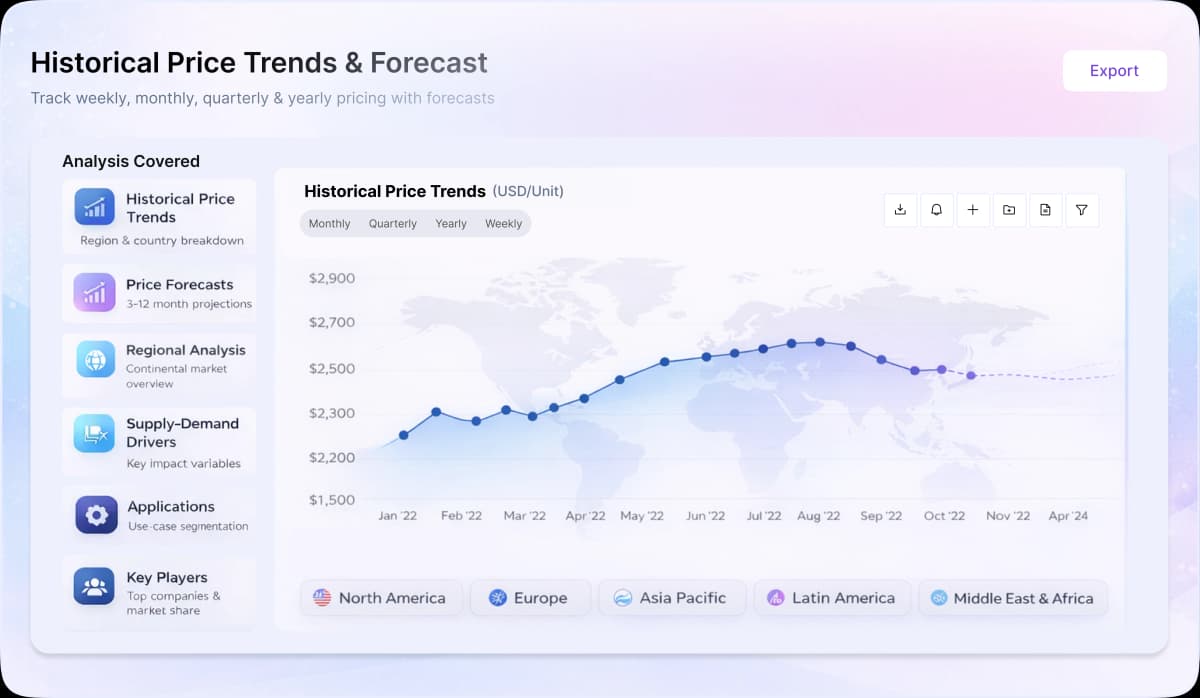
Price Trend Dashboard - What's Included
Price trends across a diverse portfolio of categories and products, spanning board to niche chemicals
Coverage extendable to grade-specific chemicals based on procurement requirements
Regular price tracking supported by robust historical datasets
News, policy updates, and key market drivers impacting price movements
Short-term and long-term price outlooks and forecasts
Supply-demand dynamics and capacity-driven market analysis