Udeesha Tomar
AVP - Strategy and Solutions
Leading procurement research solutions across chemicals, materials, and food & beverages, with expertise in price forecasting and market analytics.
| Product | Region | Incoterm Basis | Price | Last Updated Month |
|---|---|---|---|---|
| Carbon Black | China | FOB | USD 1,233.83/MT | April 2026 |
| Carbon Black | India | FOB | USD 1,283.71/MT | April 2026 |
| Carbon Black | USA | FOB | USD 1,929.13/MT | April 2026 |
| Carbon Black | Brazil | FOB | USD 1,359.83/MT | April 2026 |
| Carbon Black | Japan | CIF | USD 1,275.78/MT | April 2026 |
| Carbon Black | China | FOB | USD 1,216.78/MT | March 2026 |
| Carbon Black | China | FOB | USD 1,097.00/MT | February 2026 |
| Carbon Black | India | FOB | USD 1,217.00/MT | February 2026 |
| Carbon Black | USA | FOB | USD 1,192.00/MT | February 2026 |
| Carbon Black | Brazil | FOB | USD 1,160.00/MT | February 2026 |
| Carbon Black | Japan | CIF | USD 1,748.00/MT | February 2026 |
Stay updated with the latest Carbon Black prices, historical data, and tailored regional analysis
Asia
In Asia, prices initially remained weak in January due to declining coal tar prices and sluggish demand ahead of the Chinese New Year and Spring Festival, with downstream tire manufacturers reducing operations. Post-holiday, the market shifted as feedstock costs surged sharply, with coal tar, accounting for a major share of production costs, rising and driving price increases. Major producers raised prices multiple times, triggering a broader market response. At the same time, environmental restrictions reduced supply, tightening availability. Demand improved as downstream industries resumed operations, with nearly 50 tire manufacturers announcing price hikes due to rising input costs, reflecting strong cost transmission across the chain. The Iran war and disruptions in the Strait of Hormuz further increased logistics and energy costs, amplifying feedstock pressure and supporting prices.
Europe
In Europe, carbon black prices averaged around EUR 0.93/kg (FOB, N550) during Q1 2026, rising from nearly EUR 0.88/kg in January to EUR 0.96/kg in March, reflecting an approximate ~8.13% increase over the quarter, while quarter-on-quarter prices improved by nearly ~7.20%. The upward pricing trend was primarily supported by elevated feedstock costs, tightening global supply availability, and higher freight and energy expenses following the Iran conflict and disruptions across the Strait of Hormuz trade route. Stable demand from the rubber, tire, and industrial manufacturing sectors further strengthened market fundamentals, enabling suppliers to gradually pass on higher production costs despite cautious procurement activity across the European market.
North America
In North America, carbon black prices followed a similar upward trend, supported by higher feedstock costs and supply-side constraints. Rising coal tar and oil-linked input costs increased production expenses, while logistics disruptions tied to Middle East tensions added further pressure. Demand from tire and rubber industries improved post-holiday, though rising costs led to cautious buying behaviour and margin pressure for downstream players.
Analyst Insight
According to Procurement Resource, carbon black prices are expected to remain firm with moderate volatility, supported by sustained cost pressures and supply constraints, while downstream demand may limit sharper increases.
Related Report
Get real-time price assessments, periodic trends, forecasts and price driver insights across key global markets.
Unlock Price Insights NowOur Clients

Turn price intelligence into action with the Procurement Resource Database. Log in or subscribe to unlock live price trends, historical charts, supplier databases, cost curves, and analyst-backed insights across chemicals, agriculture, energy, packaging, and more. Use these tools to benchmark your contracts, plan budgets with confidence, and stay ahead of market moves on every product you buy.

0
+Products
0
+Regions
0
+Subscriptions
Asia
In Asia, carbon black prices during the fourth quarter witnessed mixed trends. Coal, a key feedstock for carbon black production in China, showed an upward movement at the beginning of the quarter due to tighter mine supervision and constrained supply. This increase in upstream costs supported carbon black offers and limited downward adjustments despite cautious buying from tire and rubber manufacturers. As the quarter progressed, prices first stabilized and then declined amid improving mine output and weaker downstream steel demand.
The easing of feedstock costs reduced production pressure on carbon black manufacturers, leading to softer market sentiment. Downstream demand from the tire sector remained steady but lacked strong expansion, resulting in measured procurement and limited restocking. In the latter part of the quarter, coal prices consolidated at lower levels, and carbon black prices moved within a narrower range, reflecting balanced supply and demand conditions.
Europe
In Europe, carbon black prices displayed a range-bound trajectory over quarter, resembling developments observed in the Chinese market. The prices were about 943 USD/MT (FOB) in October and around 945 USD/MT in December in the Netherlands. The period began with a gradual decline, reflecting cautious purchasing by tire manufacturers and sufficient inventory levels across the region. Demand from the automotive sector remained stable but did not accelerate, which limited upward momentum in the early phase. Mid-quarter, prices reached their lowest point before recovering steadily. The rebound aligned with firmer import offers and a modest improvement in procurement activity. As replacement costs strengthened and buyers returned to the market to replenish stocks, prices trended upward through the latter part of the quarter. By the close of the period, values had regained earlier losses and settled near the upper end of the quarterly range.
North America
North American carbon black prices followed a similar pattern, with an initial easing phase followed by a gradual recovery. Early-quarter softness was linked to steady domestic supply and controlled purchasing from tire and industrial rubber producers. Market participants maintained disciplined inventory management, contributing to the downward drift. As the quarter advanced, firmer international market signals and moderate restocking supported a rebound. Producers adjusted offers in line with improving sentiment, and prices climbed steadily during the final stretch. The quarter ended with values close to their starting levels, reflecting balanced regional fundamentals and alignment with global trends.


Carbon black is a finely divided form of amorphous carbon usually obtained via the partial combustion of hydrocarbons. The carbon black particles are usually spherical and have a high surface area to volume ratio albeit lower than activated carbon. Carbon black varies widely in particle size depending on the process by which they are made. It is often used as a pigment and reinforcing agent primarily in the automotive and rubber industries.

C
Pigments, Reinforcing Agents, Paints/Coatings, Rubber/Plastics, Printing Ink
Channel or impingement black, Furnace black, Thermal black, Lampblack, Acetylene black
Orion Engineered Carbon, Birla Carbon, Phillips Carbon Black Limited, Mitsubishi Chemical Corporation, Shandong Huadong Rubber Types Co., Ltd, Abu Dhabi National Oil Company (ADNOC)
CurrencyUS$ (Data can also be provided in local currency)
Supplier Database AvailabilityYes
Customization ScopeThe report can be customized as per the requirements of the customer
Post-Sale Analyst Support360-degree analyst support after report delivery
Note: Our supplier search experts can assist your procurement teams in compiling and validating a list of suppliers indicating they have products, services, and capabilities that meet your company's needs.
Carbon black is produced via the reaction of a hydrocarbon fuel such as gas or oil with a limited supply of combustion air at high temperatures (1320 to 1540°C). The unburnt carbon is collected as extremely fine fluffy particles.
Udeesha Tomar
AVP - Strategy and Solutions
Leading procurement research solutions across chemicals, materials, and food & beverages, with expertise in price forecasting and market analytics.
Our Price Analysis Methodology

Experience how Procurement Resource transforms raw material price data into clear, decision ready intelligence. Optimise your performance with reliable, expert market data and analysis. Schedule your demo today to experience a live walk-through where our experts will showcase interactive price charts, forecasted prices, and insights driving the prices for your key commodities, tailored to your workflows. Contact us now!
Our Team will be happy to assist you
We are just a text away
Still Need Help?
The study offers a detailed cost analysis of Carbon Black Production by Lampblack Method. In addition, the report incorporates the manufacturing process with detailed process and material flow, operating costs along with financial expenses and depreciation charges.
The study offers a detailed cost analysis of Carbon Black Production by Channel Method. In addition, the report incorporates the manufacturing process with detailed process and material flow, operating costs along with financial expenses and depreciation charges.
The study offers a detailed cost analysis of Carbon Black Production Via Furnace Method. In addition, the report incorporates the manufacturing process with detailed process and material flow, operating costs along with financial expenses and depreciation charges.
Unlock full access to Procurement Resource's price databases, interactive charts, and short-term forecasts for thousands of commodities. Elevate your sourcing decisions by comparing prices across regions, downloading historical data, and layering in analyst-backed insights, all with our flexible plans that scale as your portfolio grows.
Still have any Questions
Contact Us


Price Trend Dashboard - What's Included
Price trends across a diverse portfolio of categories and products, spanning board to niche chemicals
Coverage extendable to grade-specific chemicals based on procurement requirements
Regular price tracking supported by robust historical datasets
News, policy updates, and key market drivers impacting price movements
Short-term and long-term price outlooks and forecasts
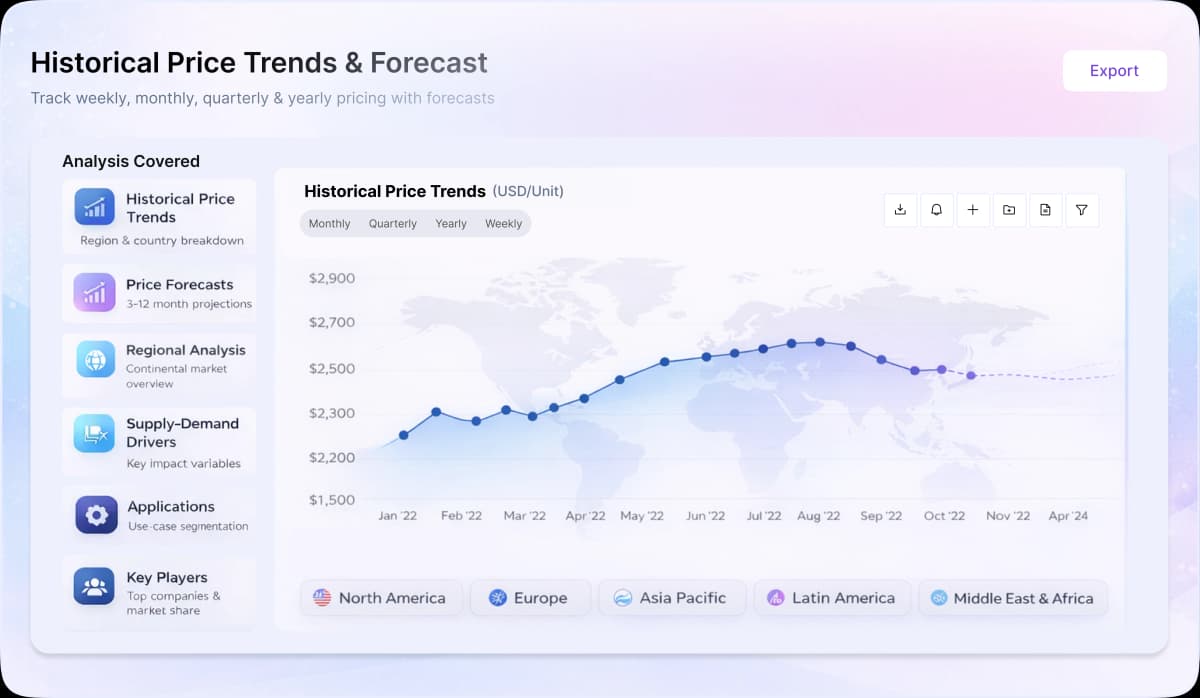
Supply-demand dynamics and capacity-driven market analysis