Need latest Ethylene Glycol prices?
Get real-time price assessments, periodic trends, forecasts and price driver insights across key global markets.
Unlock Price Insights NowOur Clients
| Product | Region | Incoterm Basis | Price | Last Updated Month |
|---|---|---|---|---|
| Ethylene Glycol | China | FOB | USD 755.88/MT | April 2026 |
| Ethylene Glycol | USA | CIF | USD 842.88/MT | April 2026 |
| Ethylene Glycol | Germany | CIF | USD 882.16/MT | April 2026 |
| Ethylene Glycol | India | CIF | USD 805.76/MT | April 2026 |
| Ethylene Glycol | Japan | CIF | USD 797.83/MT | April 2026 |
| Ethylene Glycol | China | FOB | USD 683.64/MT | March 2026 |
| Ethylene Glycol | China | FOB | USD 554.00/MT | February 2026 |
| Ethylene Glycol | USA | CIF | USD 649.00/MT | February 2026 |
| Ethylene Glycol | Germany | CIF | USD 664.00/MT | February 2026 |
| Ethylene Glycol | India | CIF | USD 674.00/MT | February 2026 |
Stay updated with the latest Ethylene Glycol prices, historical data, and tailored regional analysis
Asia
In Asia, ethylene glycol prices increased significantly during Q1’26 due to cost escalation and tightening supply. In China, the prices were ~3.95 RMB/kg (Spot FD) in January and ~4.92 RMB/kg in March, reflecting an increase of ~24.56%. The rise was driven by higher feedstock ethylene costs as crude oil prices surged due to disruptions in global energy flows. Reduced operating rates at steam crackers across Asia limited ethylene availability, tightening supply for ethylene glycol production. Buyers increasingly relied on imports due to constrained regional output, which intensified competition for cargoes and supported prices. In India, the prices were ~59.93 INR/kg (CIF) in January and ~77.19 INR/kg in March, reflecting an increase of ~28.80%. The sharper increase was influenced by strong import dependence, where higher global prices and freight costs were directly passed through to the domestic market. Tight regional supply and elevated feedstock costs further supported the upward trend, while steady demand from the polyester and textile sectors maintained procurement activity.
Europe
In Europe, ethylene glycol prices remained under pressure despite global cost support. Structural oversupply and weak downstream demand from the polyester and industrial sectors limited price recovery. Continued imports of ethylene and derivatives reduced the need for higher domestic production, while low cracker utilization rates kept supply sufficient. Although rising feedstock costs provided some support, weak industrial demand and economic uncertainty restricted any meaningful price increase.


North America
In North America, ethylene glycol prices showed limited movement, influenced by oversupply and weak downstream demand. Rising feedstock costs from higher ethane and natural gas prices increased production expenses, but these were not fully passed on due to sluggish demand conditions. Inventory levels remained adequate, and cautious purchasing behaviour from downstream industries kept the market stable with limited upward momentum.
Analyst Insight
According to Procurement Resource, ethylene glycol prices are expected to remain firm in Asia due to cost support and supply constraints, while Europe and North America may see limited movement due to weaker demand conditions.
Get real-time price assessments, periodic trends, forecasts and price driver insights across key global markets.
Unlock Price Insights NowOur Clients

Turn price intelligence into action with the Procurement Resource Database. Log in or subscribe to unlock live price trends, historical charts, supplier databases, cost curves, and analyst-backed insights across chemicals, agriculture, energy, packaging, and more. Use these tools to benchmark your contracts, plan budgets with confidence, and stay ahead of market moves on every product you buy.

0
+Products
0
+Regions
0
+Subscriptions
Asia
During the second half of 2025, ethylene glycol prices in Asia moved in a mostly downward direction. The market faced strong supply pressure as several new plants started operations and existing units ran at high rates, especially in China. Port arrivals increased after overseas units resumed production, which led to a gradual build-up of inventories. Although there was brief restocking activity ahead of holidays, it was short-lived and failed to change the overall trend. Downstream demand from polyester, textile, and PET sectors remained weak, with buyers operating cautiously and reducing inventory levels. Falling crude oil and weak ethylene oxide markets also reduced cost support.
Europe
In Europe, ethylene glycol prices declined steadily during H2’25, reflecting weak industrial activity and limited downstream demand. Consumption from key sectors such as packaging, textiles, and automotive remained below normal levels. High operating costs and slow economic growth kept buyers cautious, with many delaying purchases or limiting them to immediate needs. Import availability remained sufficient, preventing any tightening of supply. At the same time, lower energy and feedstock costs reduced production pressure but also removed price support. Even during brief periods of stable demand, sellers struggled to improve sentiment.
North America
In North America, ethylene glycol prices followed a bearish trend in H2’25. Supply remained ample due to steady plant operations and limited export movement caused by port congestion and logistical delays. Downstream demand from PET and polyester markets stayed muted, despite trade protection measures, as consumer and packaging demand did not recover strongly. Buyers adopted a wait-and-see approach and avoided long-term commitments. Weak feedstock support from crude oil and ethylene oxide further pressured the market. As a result, prices softened gradually, though the decline remained more controlled than in Asia and Europe.
Ethylene Glycol appears as a clear, colourless syrupy liquid having the ability to absorb water. It is odourless but comes with a sweet taste. The chemical is utilised to make antifreeze as well as de-icing solutions for cars, airplanes, or boats. It is also utilised in hydraulic brake fluids as well as in inks that are utilised in stamp pads, ballpoint pens, or print shops.
(CH2OH)2
Adhesives and sealant chemicals, Coolant and heat-transfer agent, Antifreeze formulations, Precursor to polymers, Dehydrating agent, Air-conditioning
1,2-ethanediol, Ethylene alcohol, Hypodicarbonous acid, Monoethylene glycol, 1,2-Dihydroxyethane, Ethane-1,2-diol
ME Global, Saudi Basic Industries Corporation (SABIC), China Petroleum & Chemical Corporation (Sinopec), Reliance Industries Limited, Shell Global, INEOS Capital Limited, India Glycols Ltd., SPDC Ltd.
CurrencyUS$ (Data can also be provided in local currency)
Supplier Database AvailabilityYes
Customization ScopeThe report can be customized as per the requirements of the customer
Post-Sale Analyst Support360-degree analyst support after report delivery
Note: Our supplier search experts can assist your procurement teams in compiling and validating a list of suppliers indicating they have products, services, and capabilities that meet your company's needs.
In this process, hydrolysis of ethylene oxide with water forms a coarse ethylene glycol combination. Further, vacuum fractional distillation is carried out to separate oligomers such as monoethylene and triethylene glycol along with water to obtain Ethylene Glycol as the result.
Our Price Analysis Methodology

Experience how Procurement Resource transforms raw material price data into clear, decision ready intelligence. Optimise your performance with reliable, expert market data and analysis. Schedule your demo today to experience a live walk-through where our experts will showcase interactive price charts, forecasted prices, and insights driving the prices for your key commodities, tailored to your workflows. Contact us now!
Our Team will be happy to assist you
We are just a text away
Still Need Help ?
This report presents a detailed cost analysis of neopentyl glycol production from isobutyraldehyde and formaldehyde through the aldol reaction.
Unlock full access to Procurement Resource's price databases, interactive charts, and short-term forecasts for thousands of commodities. Elevate your sourcing decisions by comparing prices across regions, downloading historical data, and layering in analyst-backed insights, all with our flexible plans that scale as your portfolio grows.
Still have any Questions
Contact Us


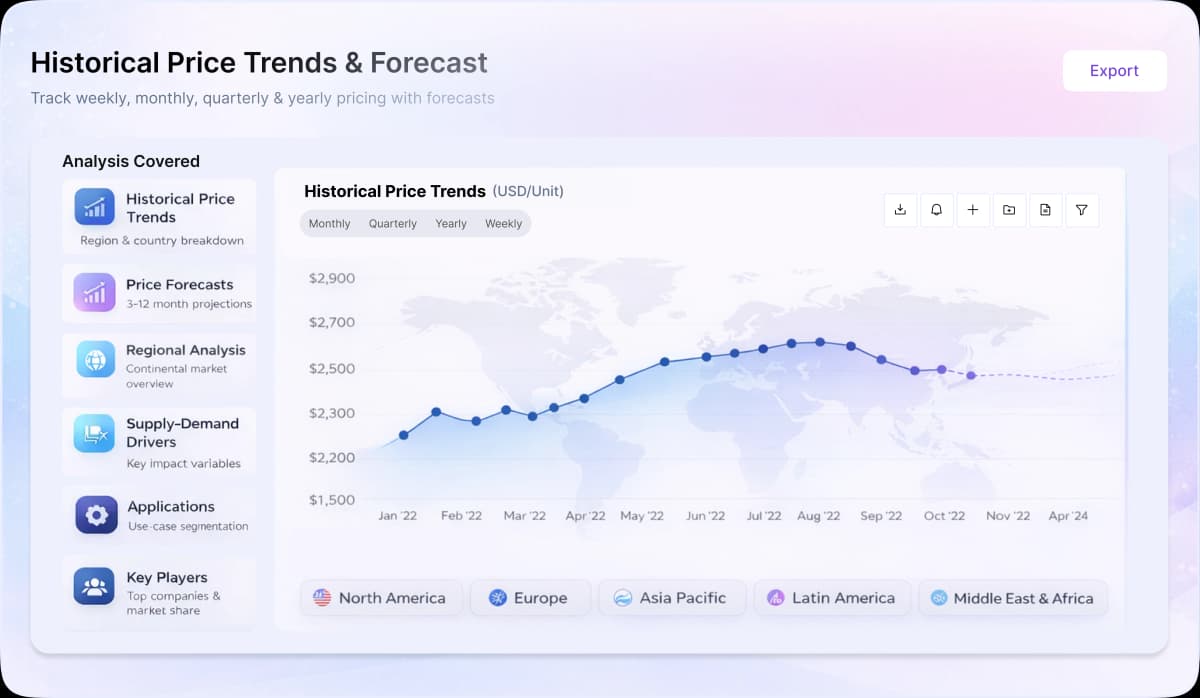
Price Trend Dashboard - What's Included
Price trends across a diverse portfolio of categories and products, spanning board to niche chemicals
Coverage extendable to grade-specific chemicals based on procurement requirements
Regular price tracking supported by robust historical datasets
News, policy updates, and key market drivers impacting price movements
Short-term and long-term price outlooks and forecasts
Supply–demand dynamics and capacity-driven market analysis