Need latest Hydrochloric Acid prices?
Get real-time price assessments, periodic trends, forecasts and price driver insights across key global markets.
Unlock Price Insights NowOur Clients
| Product | Region | Incoterm Basis | Price | Last Updated Month |
|---|---|---|---|---|
| Hydrochloric Acid | China | FOB | USD 16.77/MT | April 2026 |
| Hydrochloric Acid | USA | FOB | USD 152.10/MT | April 2026 |
| Hydrochloric Acid | Germany | CIF | USD 143.05/MT | April 2026 |
| Hydrochloric Acid | India | CIF | USD 66.65/MT | April 2026 |
| Hydrochloric Acid | Japan | CIF | USD 58.72/MT | April 2026 |
| Hydrochloric Acid | China | FOB | USD 12.42/MT | March 2026 |
| Hydrochloric Acid | India | CIF | USD 64.59/MT | March 2026 |
Stay updated with the latest Hydrochloric Acid prices, historical data, and tailored regional analysis
Asia
Hydrochloric acid prices in Asia declined sharply during Q1 2026, led by China. Prices in China fell from ~RMB 0.11/kg (Spot FD) in January to ~RMB 0.09/kg in March, marking a ~18.03% decline over the quarter and a ~5.52% drop on a quarter-on-quarter basis. The primary driver was excess supply from sustained chlor-alkali production, where higher chlorine output translated into increased HCl availability. Additionally, market sentiment weakened following the policy, where restrictions on acid exports in China increased domestic availability, further pressuring prices. On the demand side, weak steel sector activity and limited chemical consumption reduced procurement volumes, reinforcing the bearish trend.
Europe
In Europe, HCl prices witnessed a slight drop in the quarter as well, although at a relatively slower pace than the other two regions. The drop was mainly caused by improvements in supply, with stable chlor-alkali operations increasing the production of by-products. However, the demand coming from construction-based sectors was relatively slow, thus weakening the need for HCl for use in steel pickling. Further, the general problems being faced by the European chemical industry include low industrial activities due to geopolitical issues and limited demand.
North America
Prices were softer in the first quarter of 2026 in the North American region, mainly due to adequate supplies and relatively balanced demand levels. Supplies were abundant because of constant chlor-alkali production levels, resulting in the continuous availability of HCl as a by-product. Demand levels coming from oil field services and construction-related uses did not improve much, leading to no rise in prices. Moreover, steady trade flows and no disruptions in supply maintained sufficient supplies in the market.
Analyst Insight
According to Procurement Resource, Hydrochloric acid prices are expected to remain under pressure in the near term, as sufficient chlor-alkali output and modest downstream demand continue to weigh on market fundamentals.

Get real-time price assessments, periodic trends, forecasts and price driver insights across key global markets.
Unlock Price Insights NowOur Clients

Turn price intelligence into action with the Procurement Resource Database. Log in or subscribe to unlock live price trends, historical charts, supplier databases, cost curves, and analyst-backed insights across chemicals, agriculture, energy, packaging, and more. Use these tools to benchmark your contracts, plan budgets with confidence, and stay ahead of market moves on every product you buy.

0
+Products
0
+Regions
0
+Subscriptions
| Product | Category | Region | Price | Last Updated Month |
| Hydrochloric Acid | Chemicals | China | 15 USD/MT (spot FD) | December’25 |
Asia
In Asia, HCl prices showed a mixed trend during Q4’25. In China, prices rose slightly, supported by steady domestic demand and stable feedstock availability. The price in the Chinese domestic market averaged around 15 USD/MT (spot FD) in December’25. Other parts of the region saw softer price movements due to lower demand from the steel and construction sectors. Production costs remained relatively low, which limited any sharp increases. Overall, the Asian market experienced cautious buying, with downstream industries avoiding aggressive purchases as they balanced inventories and waited to see if market conditions would improve.
Europe
European HCl prices remained generally soft during the quarter. In Germany, prices continued to decline modestly, reflecting weak demand from the steel industry and a steady supply of feedstock chemicals. High production levels and slow industrial activity kept the market under pressure. Across other European markets, similar trends were observed, with manufacturers maintaining conservative purchases and focusing on cost control. The overall sentiment was cautious, with buyers responding slowly to any minor price changes.
North America
In North America, HCl prices remained mostly stable with a slight downward tendency. Prices were influenced by lower feedstock costs and weak demand from the steel sector, which saw reduced production during the quarter. Industrial activity outside steel was steady but not enough to push prices higher. Market participants generally maintained routine purchasing patterns, without significant adjustments or speculative buying.
Hydrochloric Acid, a colourless inorganic chemical system, is a simplest chlorine-based acid system that contains water. It has a characteristic pungent smell. It is grouped as strongly acidic. It is a solution made from hydrogen chloride and water, with several other chemical species like hydronium and chloride ions. Being a strong acid product with acute toxicity and corrosivity, Hydrochloric Acid is extensively used for steel pickling.
H1Cl1
Steel pickling, Pharmaceuticals, Amino acid, Monosodium glutamate, Oil well acidizing, Food manufacturing, Calcium chlorides, Ore processing
7647-01-0, Hydrogen chloride, Muriatic acid
Solvay SA, Covestro AG, Olin Corporation, BASF SE, AGC Inc, The Dow Chemical Company, Occidental Petroleum Corporation
CurrencyUS$ (Data can also be provided in local currency)
Supplier Database AvailabilityYes
Customization ScopeThe report can be customized as per the requirements of the customer
Post-Sale Analyst Support360-degree analyst support after report delivery
Note: Our supplier search experts can assist your procurement teams in compiling and validating a list of suppliers indicating they have products, services, and capabilities that meet your company's needs.
In order to produce Hydrochloric Acid from hydrogen and chloride, both the reactants are utilised in their gaseous forms, which can be obtained from the electrolysis of brine. Combustion of hydrogen and chlorine takes place, which are cooled to produce Hydrochloric Acid.
Our Price Analysis Methodology

Experience how Procurement Resource transforms raw material price data into clear, decision ready intelligence. Optimise your performance with reliable, expert market data and analysis. Schedule your demo today to experience a live walk-through where our experts will showcase interactive price charts, forecasted prices, and insights driving the prices for your key commodities, tailored to your workflows. Contact us now!
Our Team will be happy to assist you
We are just a text away
Still Need Help ?
The report revolves around the economics of production of Ammonium Chloride by reaction of gaseous ammonia with an aqueous solution of hydrochloric acid.
The report revolves around the cost analysis of EDC production by reacting ethene and hydrochloric acid using an oxychlorination method.
Unlock full access to Procurement Resource's price databases, interactive charts, and short-term forecasts for thousands of commodities. Elevate your sourcing decisions by comparing prices across regions, downloading historical data, and layering in analyst-backed insights, all with our flexible plans that scale as your portfolio grows.
Still have any Questions
Contact Us


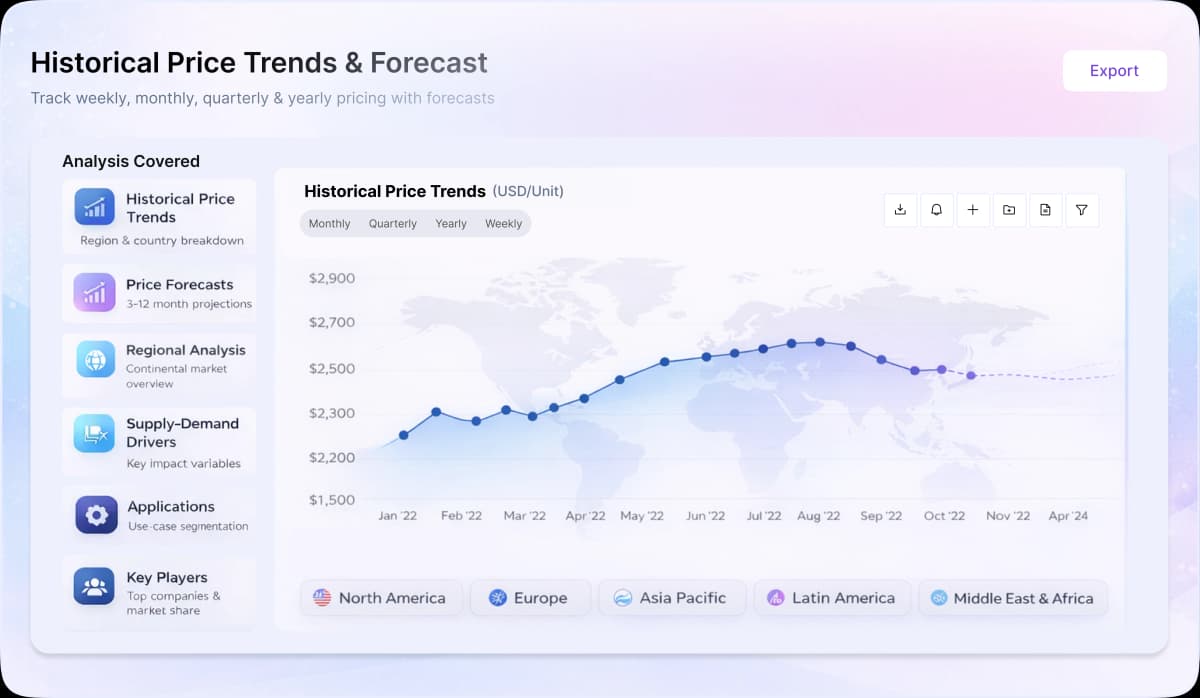
Price Trend Dashboard - What's Included
Price trends across a diverse portfolio of categories and products, spanning board to niche chemicals
Coverage extendable to grade-specific chemicals based on procurement requirements
Regular price tracking supported by robust historical datasets
News, policy updates, and key market drivers impacting price movements
Short-term and long-term price outlooks and forecasts
Supply–demand dynamics and capacity-driven market analysis