
Udeesha Tomar
AVP - Strategy and Solutions
Leading procurement research solutions across chemicals, materials, and food & beverages, with expertise in price forecasting and market analytics.

During Q2 2026, U.S. linerboard prices followed a fluctuating trend, strengthening in April, before stabilizing in May and June. The main driver was tighter supply following permanent containerboard capacity closures, reduced mill production and lower inventories. These cuts tightened open-market availability even though corrugated box demand remained relatively restrained, allowing producers to implement price increases without a major consumption surge. Several leading containerboard manufacturers announced further increases during June, reinforcing the firmer market direction. Cost pressure also remained important. Higher recovered corrugated container costs, diesel, freight, energy and logistics expenses increased mill operating and delivery costs, encouraging producers to protect margins through higher selling offers. Demand conditions improved somewhat as corrugated box orders strengthened during April and May, but consumer spending remained cautious and packaging volumes were not strong enough to explain the rise independently. The quarter was therefore primarily supply- and cost-driven, with disciplined production and inventory management supporting the market.
Analyst Insight
According to Procurement Resource, linerboard prices are expected to remain firm as reduced capacity and elevated operating costs continue to support suppliers, although weak consumer demand could limit further sharp increases.
Related Report
Need Latest Linerboard Prices?
Get real-time price assessments, periodic trends, forecasts and price driver insights across key global markets.
Our Clients


Turn price intelligence into action with the Procurement Resource Database. Log in or subscribe to unlock live price trends, historical charts, supplier databases, cost curves, and analyst-backed insights across chemicals, agriculture, energy, packaging, and more. Use these tools to benchmark your contracts, plan budgets with confidence, and stay ahead of market moves on every product you buy.
0
+Products
0
+Regions
0
+Subscriptions
Linerboard prices displayed mixed regional momentum during Q1’26 as North American markets gradually strengthened while Asian and European markets remained subdued amid weak manufacturing activity and cautious packaging demand. In the US, the American Forest & Paper Association reported total containerboard production declining 8% year-on-year during Q1’26, while export shipments fell 19%, reflecting reduced operating capacity and weaker trade flows. North American producers benefited from supply tightening after nearly 10% of regional production capacity was removed in 2025, supporting attempts to stabilize linerboard pricing despite sluggish consumption. In Asia and Europe, weak industrial packaging demand and discounted imports weighed on market sentiment. The Iran war and Strait of Hormuz disruption further intensified freight volatility, with Reuters reporting nearly 10% of the global container fleet caught in shipping congestion around Hormuz, increasing freight and insurance costs globally. Rising logistics costs affected recovered paper movement and container availability, while downstream corrugated box buyers delayed purchases due to uncertain trade conditions.
Linerboard is a grade of containerboard or paperboard mainly employed to make corrugated containers without any corrugating medium. It is made via the Kraft paper-making process using wood fibre. It has wide application across the packaging sector in many industries.
Used to make corrugated paper box cartons, folding cartons, books and stationary, interior doors, flooring, board games displays, and graphical displays.
Paperboard
Pratt Industries, Sonoco Products Company, Svenska Cellulosa Aktiebolaget, Oji Fibre Solutions (NZ) Ltd, Zhejiang Jingxing, Ji'an Group, Lee and Man, Zhejiang Rongsheng, Smurfit Kappa Group, Thai Paper Mill Co, International Paper, Universal Pulp and Paper, Mondi Group Plc, DS Smith Plc, Georgia-Pacific LLC, WestRock Company, KapStone Paper and Packaging Corporation
CurrencyUS$ (Data can also be provided in local currency)
Supplier Database AvailabilityYes
Customization ScopeThe report can be customized as per the requirements of the customer
Post-Sale Analyst Support360-degree analyst support after report delivery
Note: Our supplier search experts can assist your procurement teams in compiling and validating a list of suppliers indicating they have products, services, and capabilities that meet your company's needs.
Natural linerboard is produced from softwood trees through a series of steps. The trees are chopped into logs, which are then debarked and further chopped into wood chips. The wood chips are transformed into pulp by removing lignin through mechanical or chemical processes. The resulting pulp is washed, sprayed onto a mesh fabric, and dried to form paper, which is then wrapped around reels and transported to corrugator plants to create corrugated boxes of various designs.
Our Price Analysis Methodology
AVP - Strategy and Solutions
Leading procurement research solutions across chemicals, materials, and food & beverages, with expertise in price forecasting and market analytics.

Experience how Procurement Resource transforms raw material price data into clear, decision ready intelligence. Optimise your performance with reliable, expert market data and analysis. Schedule your demo today to experience a live walk-through where our experts will showcase interactive price charts, forecasted prices, and insights driving the prices for your key commodities, tailored to your workflows. Contact us now!
Our Team will be happy to assist you
We are just a text away
Still Need Help?
This report provides the cost structure of paper cups by pulping, bleaching, and heating processes.
Viscose Staple Fibre Manufacturing Plant Project Report thoroughly focuses on every detail that encompasses the cost of manufacturing. Our extensive cost model meticulously covers breaking down expenses around raw materials, labour, technology, and manufacturing expenses. This enables precise cost structure optimization and helps in identifying effective strategies to reduce the overall cash cost of manufacturing.
Unlock full access to Procurement Resource's price databases, interactive charts, and short-term forecasts for thousands of commodities. Elevate your sourcing decisions by comparing prices across regions, downloading historical data, and layering in analyst-backed insights, all with our flexible plans that scale as your portfolio grows.
Still have any Questions
Contact Us



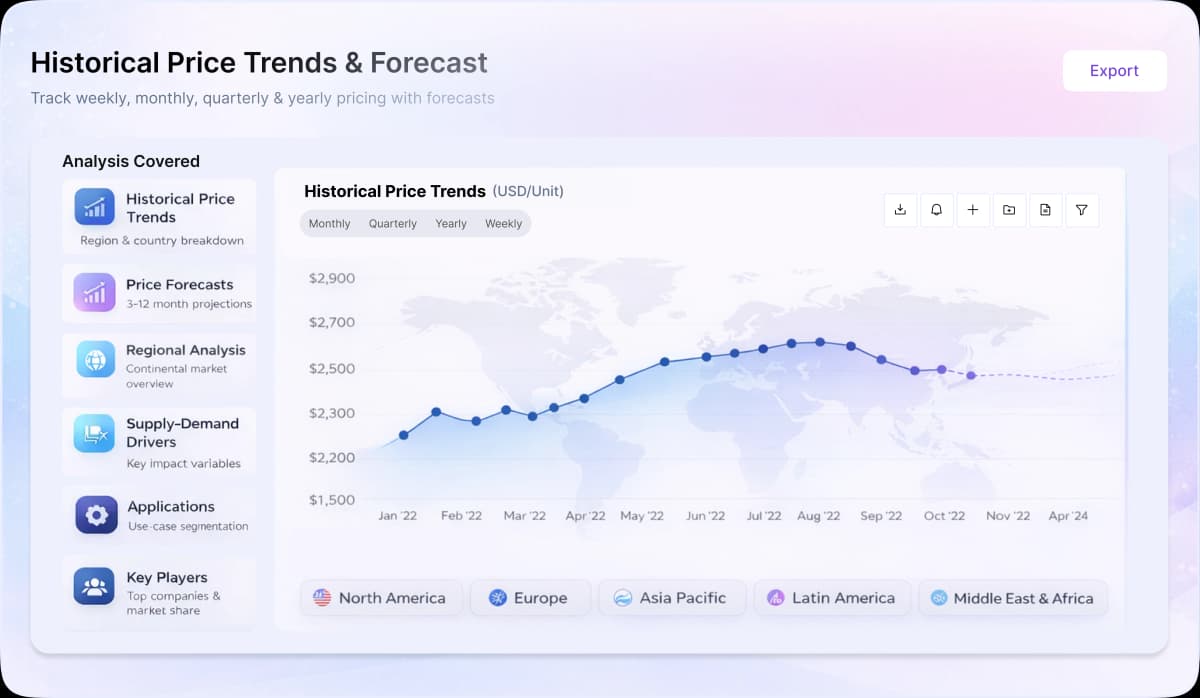
Price Trend Dashboard - What's Included
Price trends across a diverse portfolio of categories and products, spanning board to niche chemicals
Coverage extendable to grade-specific chemicals based on procurement requirements
Regular price tracking supported by robust historical datasets
News, policy updates, and key market drivers impacting price movements
Short-term and long-term price outlooks and forecasts
Supply–demand dynamics and capacity-driven market analysis

Track prices, market movements, supply-demand dynamics, and industry developments across hundreds of commodities through a centralized intelligence platform built for informed procurement decisions.

Understand market fluctuations using analyst-backed forecasts, historical pricing patterns, and evolving industry trends to strengthen sourcing strategies and budget planning.

Leverage cost models, pricing benchmarks, and procurement insights to evaluate purchasing opportunities, improve negotiations, and enhance operational efficiency.
Access region-specific price trends, trade activities, capacity changes, and supply chain developments influencing commodity markets worldwide.