Udeesha Tomar
AVP - Strategy and Solutions
Leading procurement research solutions across chemicals, materials, and food & beverages, with expertise in price forecasting and market analytics.

In 2025, mild steel plate prices moved unevenly across the year. Early in the year, the market was quiet as industrial demand from construction, automotive, and machinery sectors remained slow. Buyers were cautious, and seasonal inactivity kept transactions limited. Oversupply in Asia and weaker domestic demand in some countries put downward pressure on prices, while in Europe, high stock levels prevented significant gains despite producers’ efforts. In North America, prices held steady as trade protections and moderate industrial activity helped maintain balance. In India, low prices forced several small producers to pause production, highlighting the strain on profitability due to global oversupply and cheaper imports.
As the year progressed, prices began to rise in some regions. European markets gained support from expected import restrictions and tighter trade policies, encouraging domestic producers to increase offers. Seasonal demand and slightly higher raw material costs in parts of Asia supported modest price gains, although cautious buying limited rapid increases. By the end of the year, markets stabilized, with prices slightly higher where supply tightened and demand slowly recovered.
Analyst Insight
According to Procurement Resource, Mild Steel Plate prices are likely to stay fluctuating in 2026, with modest upward pressure if industrial activity and infrastructure demand continue to improve.
Related Report
Get real-time price assessments, periodic trends, forecasts and price driver insights across key global markets.
Unlock Price Insights NowOur Clients

Turn price intelligence into action with the Procurement Resource Database. Log in or subscribe to unlock live price trends, historical charts, supplier databases, cost curves, and analyst-backed insights across chemicals, agriculture, energy, packaging, and more. Use these tools to benchmark your contracts, plan budgets with confidence, and stay ahead of market moves on every product you buy.

0
+Products
0
+Regions
0
+Subscriptions
In 2024, mild steel plate prices experienced mixed trends across different regions. In the first quarter, prices were generally stable in Asia as domestic construction and infrastructure projects maintained steady demand, despite weak international buying. China’s real estate market remained slow, affecting overall demand, while India’s ongoing public infrastructure projects helped support local prices. In Europe and North America, prices saw a slight decline early in the year due to high inflation, subdued industrial activity, and cautious buying from manufacturers.
During the second quarter, the market showed varied movements. In Asia, prices remained relatively steady as supply and demand were balanced, though weak exports limited significant growth. Europe faced downward pressure from rising raw material costs and logistics challenges, while imports from Asia increased competition. North American prices edged upward slightly, supported by demand from construction, automotive, and industrial sectors. Limited availability of steel scrap added some volatility to prices in multiple regions.
In the second half of the year, prices again showed mixed behaviour. Asian markets saw some decline due to weak domestic demand and surplus production from China, while India experienced local price drops. European prices recovered modestly as raw material costs rose and producers adjusted their offers, though imports and weak sectoral demand kept gains moderate. North American markets showed signs of stabilization, aided by improving domestic demand and seasonal buying patterns.
Mild Steel Plate is a kind of carbon steel plate containing low amount of carbon. Mild steel is also called as “low carbon steel” as the amount of carbon found in mild steel ranges from 0.05% to 0.25% by weight as opposed to high carbon steel, which contains 0.30% to 2.0% carbon.
It is different from alloy steel and does not contain large amount of alloying elements other than iron. Owing to the presence of low carbon, it is more ductile, weldable, and machinable as compared to carbon and other steels. Mild steel is a general purpose steel that is used in most things starting from table frames to cargo ships.
Flanging and forming, Fabrication , Atmospheric corrosion resistance products, Boilers and pressure vessels, Penstock, Ship building, Oil and gas equipments, Automobile body parts, Pipeline manufacturing, Industrial flooring, Galvanizing pots, Engineering application
M.S. plates , Low carbon steel plates
POSCO , Hico Multifin Products Private Limited, Gravita India Ltd, Canada Metal North America Ltd, Jamestown North America, Boliden Group
CurrencyUS$ (Data can also be provided in local currency)
Supplier Database AvailabilityYes
Customization ScopeThe report can be customized as per the requirements of the customer
Post-Sale Analyst Support360-degree analyst support after report delivery
Note: Our supplier search experts can assist your procurement teams in compiling and validating a list of suppliers indicating they have products, services, and capabilities that meet your company's needs.
Production of Mild Steel Plates generally involve three major steps, viz. primary steelmaking, secondary steelmaking, and casting. Iron ore, coke and lime are obtained and melted together in a blast furnace to produce virgin steel. Once melted, the mixture is transferred to another furnace to remove impurities and make other adjustments to steel’s chemical composition with the addition of carbon and other elements, thus producing mild steel. Then, the obtained product is allowed to solidify into a rectangular shape, which is subsequently brought down to the desired size via hot rolling, cold drawing, etc.

AVP - Strategy and Solutions
Leading procurement research solutions across chemicals, materials, and food & beverages, with expertise in price forecasting and market analytics.
Our Price Analysis Methodology

Experience how Procurement Resource transforms raw material price data into clear, decision ready intelligence. Optimise your performance with reliable, expert market data and analysis. Schedule your demo today to experience a live walk-through where our experts will showcase interactive price charts, forecasted prices, and insights driving the prices for your key commodities, tailored to your workflows. Contact us now!
Our Team will be happy to assist you
We are just a text away
Still Need Help?
This report provides the cost structure of tinplate by strip mill process. In this process, the hot rolled steel sheets are pickled in acid to remove the iron oxide layer formed.
Dry leaves of stevia rebaudiana are immersed in hot water to extract steviol glycosides, which is the main sweetening element in stevia.
Unlock full access to Procurement Resource's price databases, interactive charts, and short-term forecasts for thousands of commodities. Elevate your sourcing decisions by comparing prices across regions, downloading historical data, and layering in analyst-backed insights, all with our flexible plans that scale as your portfolio grows.
Still have any Questions
Contact Us


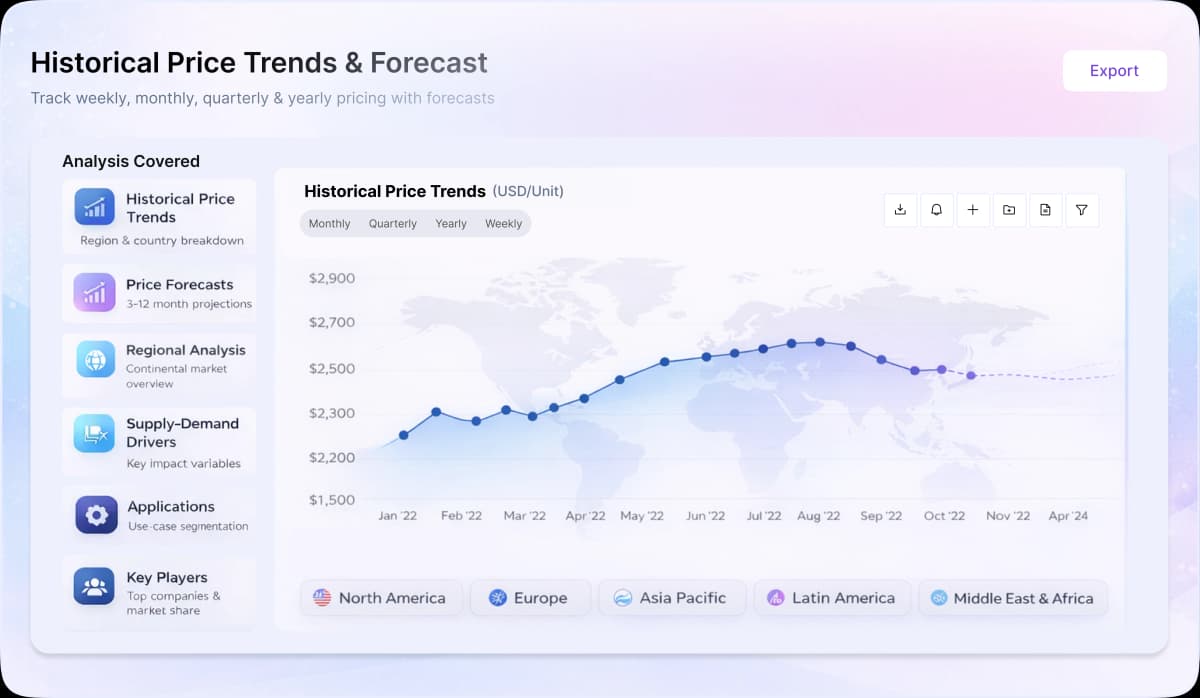
Price Trend Dashboard - What's Included
Price trends across a diverse portfolio of categories and products, spanning board to niche chemicals
Coverage extendable to grade-specific chemicals based on procurement requirements
Regular price tracking supported by robust historical datasets
News, policy updates, and key market drivers impacting price movements
Short-term and long-term price outlooks and forecasts
Supply-demand dynamics and capacity-driven market analysis