Need latest Modified Starch prices?
Get real-time price assessments, periodic trends, forecasts and price driver insights across key global markets.
Unlock Price Insights NowOur Clients
In 2025, the modified starch market moved through a year of sharp changes as the supply of base starches shifted across regions. In the first half, prices weakened in many Asian countries because the availability of raw materials was unusually high. Large inventories built up after strong harvests, and many manufacturers struggled with low demand from food, paper, and industrial sectors. Competition from cheaper alternatives also kept buyers cautious, which prevented producers from raising prices. Some regions additionally dealt with softer export inquiries, making it harder for processors to move excess stock. This kept market sentiment subdued and pushed modified starch prices downward.
During the second half of the year, the price trend became more mixed. In North America, frequent disruptions in agricultural and trade flows caused short-term spikes in the cost of raw materials, which lifted production costs for modified starch. Strong interest from food and packaging industries also supported higher buying activity. Meanwhile, Europe saw continued tightness in certain raw inputs due to weather-related crop challenges and logistic delays, which added mild upward pressure. Even so, the broader market remained cautious, as buyers remembered the earlier oversupply and continued to manage inventories carefully. In parts of Asia, export expansion efforts brought some improvement, but ongoing global price softness limited the extent of recovery.
Overall, 2025 ended with a market that was steadier than the first half but still influenced heavily by raw material supply, shifting trade patterns, and uneven demand growth.
Analyst Insight
According to Procurement Resource, Modified Starch prices are expected to stay stable to slightly firm, depending on raw material availability and the pace of recovery in food and industrial demand.
Get real-time price assessments, periodic trends, forecasts and price driver insights across key global markets.
Unlock Price Insights NowOur Clients

Turn price intelligence into action with the Procurement Resource Database. Log in or subscribe to unlock live price trends, historical charts, supplier databases, cost curves, and analyst-backed insights across chemicals, agriculture, energy, packaging, and more. Use these tools to benchmark your contracts, plan budgets with confidence, and stay ahead of market moves on every product you buy.

0
+Products
0
+Regions
0
+Subscriptions
In 2024, the modified starch market moved through a year of shifting supply conditions and uneven demand. In the first half, prices in several regions stayed under pressure due to high production costs, unstable energy markets, and unpredictable agricultural flows. Processors struggled with the rising cost of grains and root crops used to make base starches. Weather issues and geopolitical tensions added more uncertainty, making it harder for manufacturers to keep operations efficient. Even with these challenges, demand from industrial users remained steady, which helped prevent a sharper decline in the market. Many producers tried to optimize their processing steps to stay competitive, but some varieties of modified starch became less available because of limited raw material supply.
In the second half of the year, the market turned firmer. Raw material prices for several starch sources increased, driven by poor crop yields in some areas, higher farming costs, and transport disruptions. This pushed production expenses higher for modified starch makers as well. Demand from food, paper, and pharmaceutical sectors stayed healthy, supporting an upward trend in many regions. Users were more willing to secure supply early as concerns about tighter availability grew. However, some segments still saw resistance from buyers, which kept the price rise moderate in a few markets. Overall, 2024 ended with a stronger tone compared to the first half, supported by tighter supply, rising feedstock costs, and steady industrial demand.
Modified starch is the starch with modified or altered properties. It can be produced through physical, enzymatic, or chemical treatment of native starch, a pure form of starch. These modified variants are developed to enhance the performance of starch in different applications. For instance, starches can be modified to improve their stability against excessive heat, acid, time, cooling or freezing; or to change their texture, etc. Modified starches are practically utilised in all starch applications like in food texturising and stabilising, or as a binder in coated paper manufacturing.
Starch Derivatives
Thickening agent, Stabiliser, Papermaking, Adhesives, Emulsifier, Pharmaceuticals
Cargill, Incorporated, Novidon B.V. Tereos SA, Archer Daniels Midland Company (ADM), Roquette Frères SA, Ingredion Incorporated, Tate & Lyle PLC
CurrencyUS$ (Data can also be provided in local currency)
Supplier Database AvailabilityYes
Customization ScopeThe report can be customized as per the requirements of the customer
Post-Sale Analyst Support360-degree analyst support after report delivery
Note: Our supplier search experts can assist your procurement teams in compiling and validating a list of suppliers indicating they have products, services, and capabilities that meet your company's needs.
While using the physically modifying, process to produce the Modified Starch, the starch granules are treated under different conditions, pressures as well as different temperatures.
Our Price Analysis Methodology

Experience how Procurement Resource transforms raw material price data into clear, decision ready intelligence. Optimise your performance with reliable, expert market data and analysis. Schedule your demo today to experience a live walk-through where our experts will showcase interactive price charts, forecasted prices, and insights driving the prices for your key commodities, tailored to your workflows. Contact us now!
Our Team will be happy to assist you
We are just a text away
Still Need Help ?
This report provides the cost structure of cassava starch production from the wet milling process. In this process, cassava roots are peeled and washed before being grated.

This report provides the cost structure of potato starch production from the extraction process.

This report provides the cost structure of corn starch production from the wet milling process. Corn is soaked in water for at least two days in order to ferment a little.
This report provides the cost structure of native starch production from the wet technique. Starch is extracted from seeds, roots, and tubers of a starch-rich crop.
This report provides the cost structure of wheat starch production from the Martin process. Martin process refers to the wet milling process.
Unlock full access to Procurement Resource's price databases, interactive charts, and short-term forecasts for thousands of commodities. Elevate your sourcing decisions by comparing prices across regions, downloading historical data, and layering in analyst-backed insights, all with our flexible plans that scale as your portfolio grows.
Still have any Questions
Contact Us


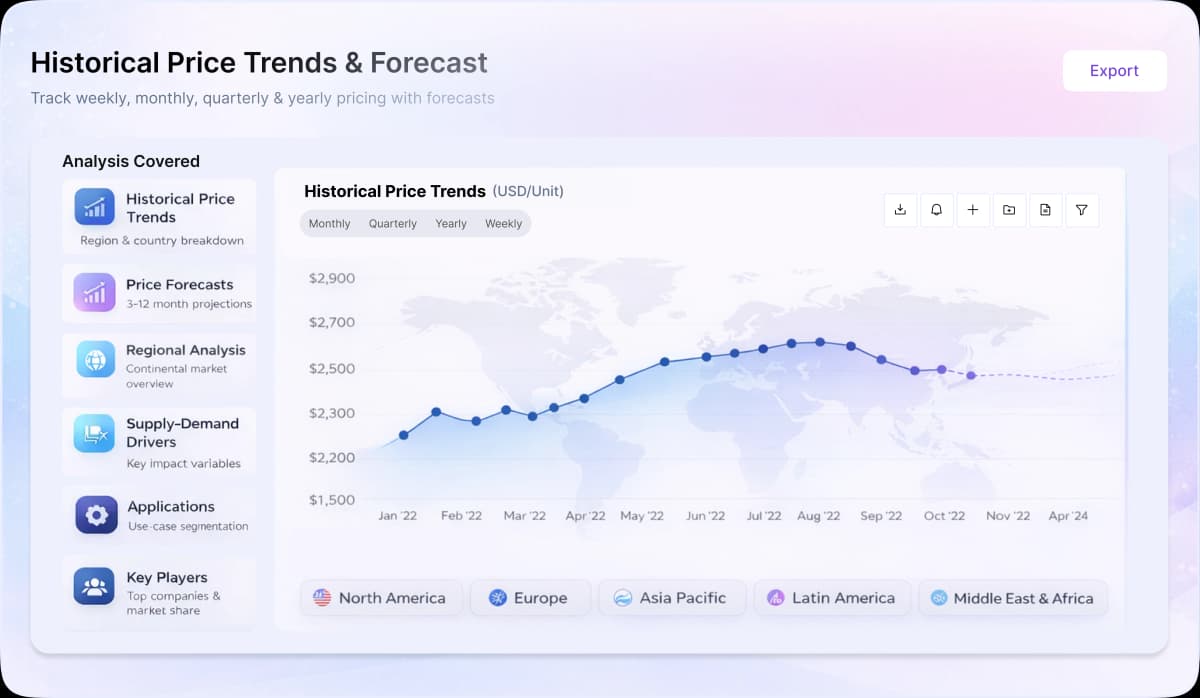
Price Trend Dashboard - What's Included
Price trends across a diverse portfolio of categories and products, spanning board to niche chemicals
Coverage extendable to grade-specific chemicals based on procurement requirements
Regular price tracking supported by robust historical datasets
News, policy updates, and key market drivers impacting price movements
Short-term and long-term price outlooks and forecasts
Supply–demand dynamics and capacity-driven market analysis