Palladium Futures Rise on Market Optimism
The palladium main futures contract increased, reflecting bullish sentiment from Fed remarks, oversold conditions, and demand from automotive catalysts and hydrogen energy.

The palladium main futures contract increased, reflecting bullish sentiment from Fed remarks, oversold conditions, and demand from automotive catalysts and hydrogen energy.
Platinum group metal mining production in South Africa dropped sharply in August 2026, cutting output and reducing available supply. The decline is expected to lift upward pressure on PGM prices due to tighter market conditions.
| Product | Region | Incoterm Basis | Price | Last Updated Month |
|---|---|---|---|---|
| Palladium | China | CIF | USD 1,353.84/Ounce | August 2026 |
| Palladium | India | CIF | USD 1,353.84/Ounce | August 2026 |
| Palladium | USA | CIF | USD 1,353.84/Ounce | August 2026 |
| Palladium | Brazil | CIF | USD 1,353.84/Ounce | August 2026 |
| Palladium | Germany | FOB | USD 1,353.84/Ounce | August 2026 |
| Palladium | China | CIF | USD 1,277.20/Ounce | July 2026 |
| Palladium | India | CIF | USD 1,277.20/Ounce | July 2026 |
| Palladium | USA | CIF | USD 1,277.20/Ounce | July 2026 |
| Palladium | Brazil | CIF | USD 1,277.20/Ounce | July 2026 |
| Palladium | Germany | FOB | USD 1,277.20/Ounce | July 2026 |
Stay updated with the latest Palladium prices, historical data, and tailored regional analysis
Palladium prices weakened in Q2’26 as the demand side became the main pressure point, especially for autocatalyst consumption. Lower gasoline-car production reduced fresh buying from catalyst manufacturers, while battery-electric vehicle growth continued to cut palladium use per vehicle. Official Chinese auto data showed May vehicle sales declined 2.1% year-on-year, while new-energy vehicles accounted for 56.9% of new-vehicle sales, directly limiting palladium intensity in the fleet mix. Exports partly supported automobile production, with vehicle exports rising 68.7% year-on-year in May, but the benefit to palladium was diluted because a rising share of exported vehicles was electrified. On the supply side, Russian production cuts gave some support, yet available supply and recycling kept the market from tightening sharply. The key Q2 shift was that palladium’s traditional demand base weakened faster than supply risks could lift sentiment.
Analyst Insight
According to Procurement Resource, in the near term, palladium may remain demand-sensitive, with limited upside unless gasoline and hybrid catalyst demand improves or mine supply tightens more sharply.
Related Report
Need Latest Palladium Prices?
Get real-time price assessments, periodic trends, forecasts and price driver insights across key global markets.
Our Clients


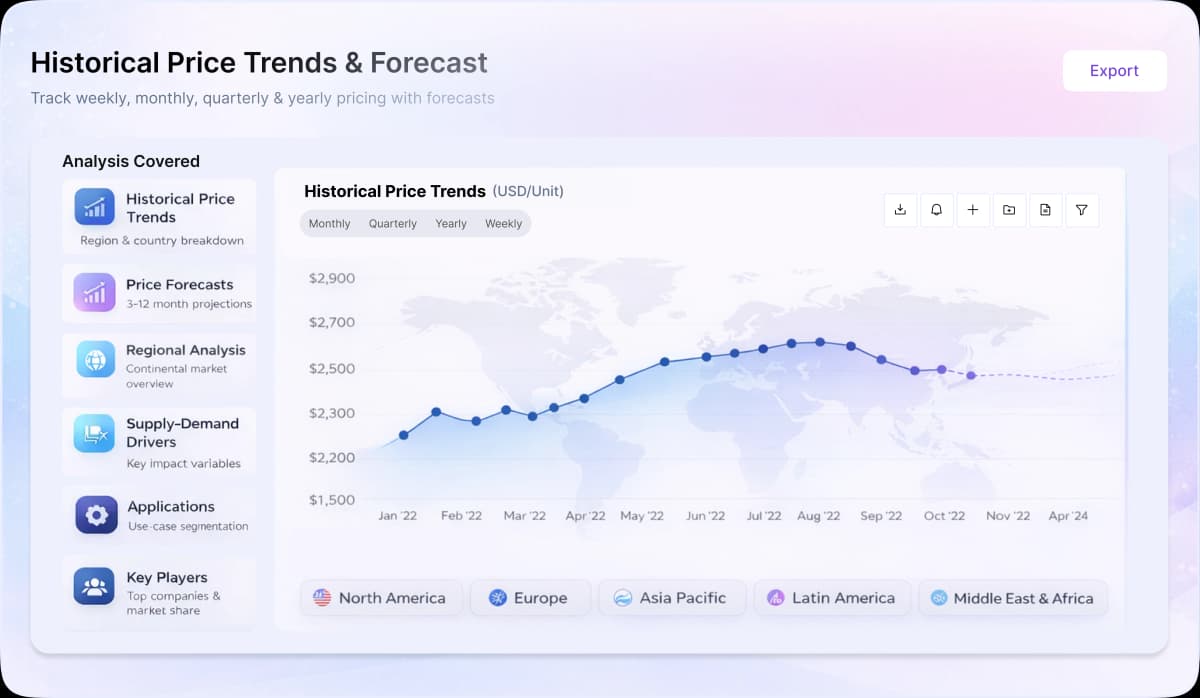
Turn price intelligence into action with the Procurement Resource Database. Log in or subscribe to unlock live price trends, historical charts, supplier databases, cost curves, and analyst-backed insights across chemicals, agriculture, energy, packaging, and more. Use these tools to benchmark your contracts, plan budgets with confidence, and stay ahead of market moves on every product you buy.
0
+Products
0
+Regions
0
+Subscriptions
The palladium market exhibited a volatile pattern during Q1’26. Initially, the palladium price curve experienced a downward trajectory due to the strong performance of the U.S. dollar, high bond yields, profit-taking after price appreciation, and declining demand for automobiles. The ongoing transition from internal combustion engines to electric vehicles further contributed to the lower utilization of palladium in exhaust systems, alongside steady production levels and increased recycling rates, causing an oversupply that caused the drop in price.
Nonetheless, towards the end of Q1’26, the market witnessed a reversal of fortune in terms of prices as growing geopolitical tensions in Iran and the Middle East raised fears of disruptions to the supply chain, causing the prices to recover. Other supportive factors included the attempts by key palladium producers to boost industrial demand outside the auto sector.
Palladium is a well-known chemical element which is a nickel group element atom, a platinum group metal atom as well as a metal allergen. Palladium is one of the rare and lustrous silvery-white metal. It has the lowest melting point and is the least dense of platinum group metals. The main use for Palladium is in catalytic converters for the automotive industry.
Pd
Catalytic reactions, Hydrogenation of unsaturated hydrocarbons, Jewellery, Dental fillings, Electronics and technoogy, Crowns, Catalytic converter, Automotive industry
Palladium on Carbon, Palladium Black, Paladio
Norilsk Nickel Mining and Metallurgical Company, Russian Platinum, Johnson Matthey, Heraeus Holding, Shanxi Kaida Chemical Engineering Co., Ltd, Anglo American Platinum Ltd
CurrencyUS$ (Data can also be provided in local currency)
Supplier Database AvailabilityYes
Customization ScopeThe report can be customized as per the requirements of the customer
Post-Sale Analyst Support360-degree analyst support after report delivery
Note: Our supplier search experts can assist your procurement teams in compiling and validating a list of suppliers indicating they have products, services, and capabilities that meet your company's needs.
Palladium can be found in deposits alloyed with gold and other platinum-group metals, including nickel–copper deposits, and from there it is mined. Though at a commercial scale, its production starts from the residue of the production of another metal, generally nickel.
Firstly, the residue is dissolved in aqua regia, that allows various metals present in it to form their nitrates. If silver is found to be present, then it is removed by forming silver chloride. When distinct types of elements are added to the mixture, all the elements get separated, thus, allowing manufacturers to extract Palladium.
Our Price Analysis Methodology

Senior Business Insights Analyst
Delivering price trend analysis and procurement market insights at Procurement Resource, with expertise in identifying commodity patterns, supporting purchasing strategies, and improving cost efficiency through actionable market intelligence.

Experience how Procurement Resource transforms raw material price data into clear, decision ready intelligence. Optimise your performance with reliable, expert market data and analysis. Schedule your demo today to experience a live walk-through where our experts will showcase interactive price charts, forecasted prices, and insights driving the prices for your key commodities, tailored to your workflows. Contact us now!
Our Team will be happy to assist you
We are just a text away
Still Need Help?
This report shows the cost structure of hydrogen production from the electrolysis process.
The report involves the cost analysis of production of hydrogen peroxide by the anthraquinone process.
Unlock full access to Procurement Resource's price databases, interactive charts, and short-term forecasts for thousands of commodities. Elevate your sourcing decisions by comparing prices across regions, downloading historical data, and layering in analyst-backed insights, all with our flexible plans that scale as your portfolio grows.
Still have any Questions
Contact Us



Price Trend Dashboard - What's Included
Price trends across a diverse portfolio of categories and products, spanning board to niche chemicals
Coverage extendable to grade-specific chemicals based on procurement requirements
Regular price tracking supported by robust historical datasets
News, policy updates, and key market drivers impacting price movements
Short-term and long-term price outlooks and forecasts
Supply–demand dynamics and capacity-driven market analysis

Track prices, market movements, supply-demand dynamics, and industry developments across hundreds of commodities through a centralized intelligence platform built for informed procurement decisions.

Understand market fluctuations using analyst-backed forecasts, historical pricing patterns, and evolving industry trends to strengthen sourcing strategies and budget planning.

Leverage cost models, pricing benchmarks, and procurement insights to evaluate purchasing opportunities, improve negotiations, and enhance operational efficiency.
Access region-specific price trends, trade activities, capacity changes, and supply chain developments influencing commodity markets worldwide.