Need latest Polybutylene Terephthalate prices?
Get real-time price assessments, periodic trends, forecasts and price driver insights across key global markets.
Unlock Price Insights NowOur Clients
Asia
During the first half of 2025, PBT prices in the Asia-Pacific region showed mixed trends. Early in the year, demand remained soft due to cautious buying and minimal restocking ahead of the Chinese New Year.
Export activity was sluggish, influenced by global economic uncertainties and ongoing trade tensions. Mid-quarter, prices picked up slightly as upstream Purified Terephthalic Acid (PTA) costs rose and industrial activity resumed post-holidays.
However, this improvement was short-lived. By the end of Q2, oversupply and weakening downstream demand—especially in the automotive and electronics sectors—led to renewed price pressure. Production was stable, but high inventories and slow consumption rates capped any significant gains.
Europe
In Europe, PBT prices declined modestly over H1’25. The market started off steady with balanced supply, but demand from the automotive sector was weak due to limited vehicle sales and cautious procurement behaviour. Midway through the period, a temporary price lift occurred as PTA costs edged up and some restocking activity surfaced.
However, as the quarter closed, falling raw material prices and increased import competition—especially from Asia—drove prices down again. Consumption across end-use industries remained subdued, and European producers struggled with high energy costs and tepid market confidence.
North America
In North America, PBT prices experienced mild fluctuations. The beginning of 2025 saw slight declines, reflecting stable feedstock costs and slow demand, particularly in the manufacturing and automotive sectors. Labour issues were resolved early in the quarter, easing supply chain pressures.
Prices saw a brief rise mid-period, triggered by supply disruptions and a jump in PTA prices. Still, this was not enough to drive a strong rebound, as export orders weakened and economic sentiment stayed cautious. By late Q2, prices stabilized again as feedstock markets cooled and domestic demand held steady, though unspectacular.
Analyst Insight
According to Procurement Resource, price movements are likely to stay tied to upstream cost dynamics and global economic signals, with only mild recovery expected unless downstream demand improves meaningfully.
Related Report
Get real-time price assessments, periodic trends, forecasts and price driver insights across key global markets.
Unlock Price Insights NowOur Clients

Turn price intelligence into action with the Procurement Resource Database. Log in or subscribe to unlock live price trends, historical charts, supplier databases, cost curves, and analyst-backed insights across chemicals, agriculture, energy, packaging, and more. Use these tools to benchmark your contracts, plan budgets with confidence, and stay ahead of market moves on every product you buy.

0
+Products
0
+Regions
0
+Subscriptions
Asia
In Asia, particularly China, Polybutylene Terephthalate (PBT) prices showed a downward trend throughout Q4'24. The market was primarily influenced by weak demand from the automotive sector, especially in the electric vehicle segment. The decline in feedstock prices, particularly Purified Terephthalic Acid (PTA), contributed to lower production costs.
The textile and plastics industries also displayed subdued purchasing patterns, which further weakened the market sentiment. Despite some attempts by manufacturers to stimulate demand through discounts, the overall market remained bearish.
Europe
European PBT markets, led by Germany, experienced a slight decline during Q4'24. The automotive sector, a key consumer of PBT, faced significant challenges with lower production volumes and decreased new car registrations. The electric vehicle segment particularly struggled, showing reduced growth compared to previous quarters. The market was also affected by ongoing trade uncertainties and regulatory concerns, especially regarding recycled content requirements in plastic products. Feedstock costs remained relatively stable, but this did little to support PBT prices amid weak demand.
North America
The North American PBT market maintained relative stability during Q4'24, despite some underlying challenges. While the automotive sector showed steady demand, the impact of natural disasters and varying consumer sentiment created some market volatility. The stability in feedstock prices, including PTA and Butanediol, helped maintain steady production costs. However, market growth was limited by cautious buying patterns and adequate inventory levels among manufacturers.
PBT is a semi-aromatic, semi-crystalline thermoplastic belonging to the class of polyesters. It is an essential class of polyesters due to its attractive properties like high tensile strength, good resistance to chemical stresses, durability, heat resistance, etc. It can be easily moulded and thermoformed and is closely related to PET (Polyethylene terephthalate). Compared to PET, it has somewhat lower strength but is more flexible than PET.
(C12H12)O4)n
Electrical Insulators, Automotives, Fibre Optic Cables, Fire-safe Polymers, Switches, Electrical Components
PBT, Poly(oxy-1,4-butanediyloxycarbonyl-1,4-phenylenecarbonyl)
Almaak International GmbH, BASF SE, Celanese Corporation, DowDuPont, Inc., Chang Chun Group, Enviroplas, Inc.
CurrencyUS$ (Data can also be provided in local currency)
Supplier Database AvailabilityYes
Customization ScopeThe report can be customized as per the requirements of the customer
Post-Sale Analyst Support360-degree analyst support after report delivery
Note: Our supplier search experts can assist your procurement teams in compiling and validating a list of suppliers indicating they have products, services, and capabilities that meet your company's needs.
PBT is produced by polycondensation of terephthalic acid or dimethyl terephthalate with 1,4–butanediol in the presence of special catalysts like titanium, tin, or germanium derivatives to obtain high molecular mass polymers.

Our Price Analysis Methodology

Experience how Procurement Resource transforms raw material price data into clear, decision ready intelligence. Optimise your performance with reliable, expert market data and analysis. Schedule your demo today to experience a live walk-through where our experts will showcase interactive price charts, forecasted prices, and insights driving the prices for your key commodities, tailored to your workflows. Contact us now!


Our Team will be happy to assist you
We are just a text away
Still Need Help ?
Unlock full access to Procurement Resource's price databases, interactive charts, and short-term forecasts for thousands of commodities. Elevate your sourcing decisions by comparing prices across regions, downloading historical data, and layering in analyst-backed insights, all with our flexible plans that scale as your portfolio grows.
Still have any Questions
Contact Us


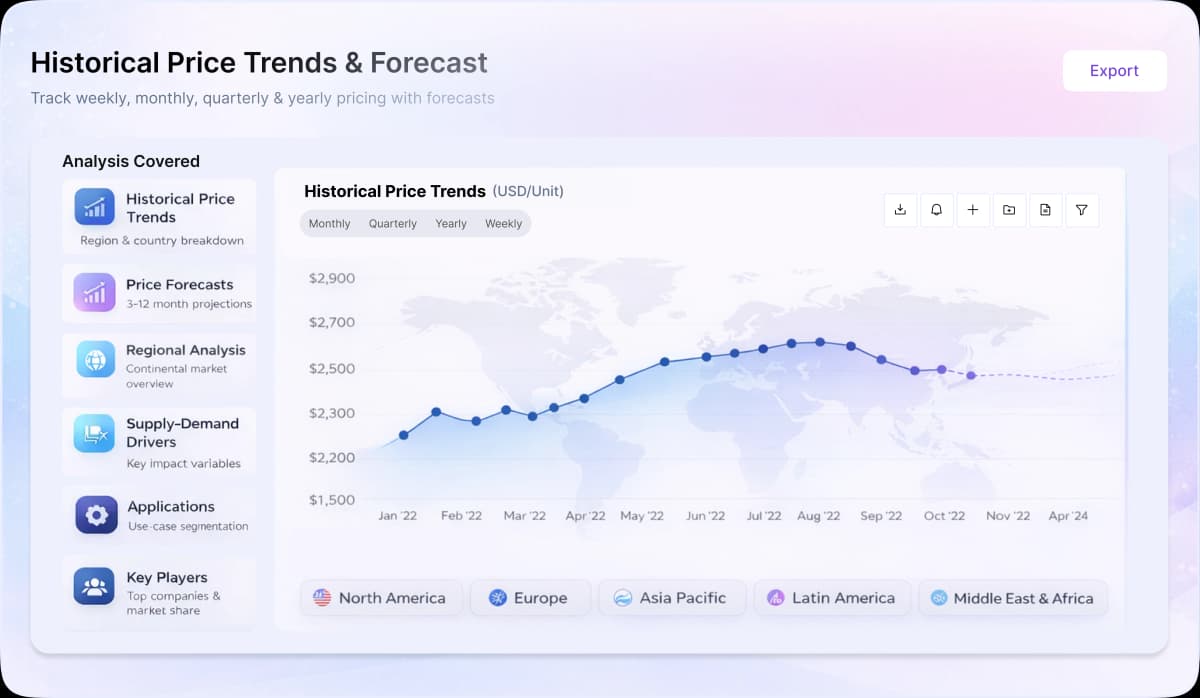
Price Trend Dashboard - What's Included
Price trends across a diverse portfolio of categories and products, spanning board to niche chemicals
Coverage extendable to grade-specific chemicals based on procurement requirements
Regular price tracking supported by robust historical datasets
News, policy updates, and key market drivers impacting price movements
Short-term and long-term price outlooks and forecasts
Supply–demand dynamics and capacity-driven market analysis