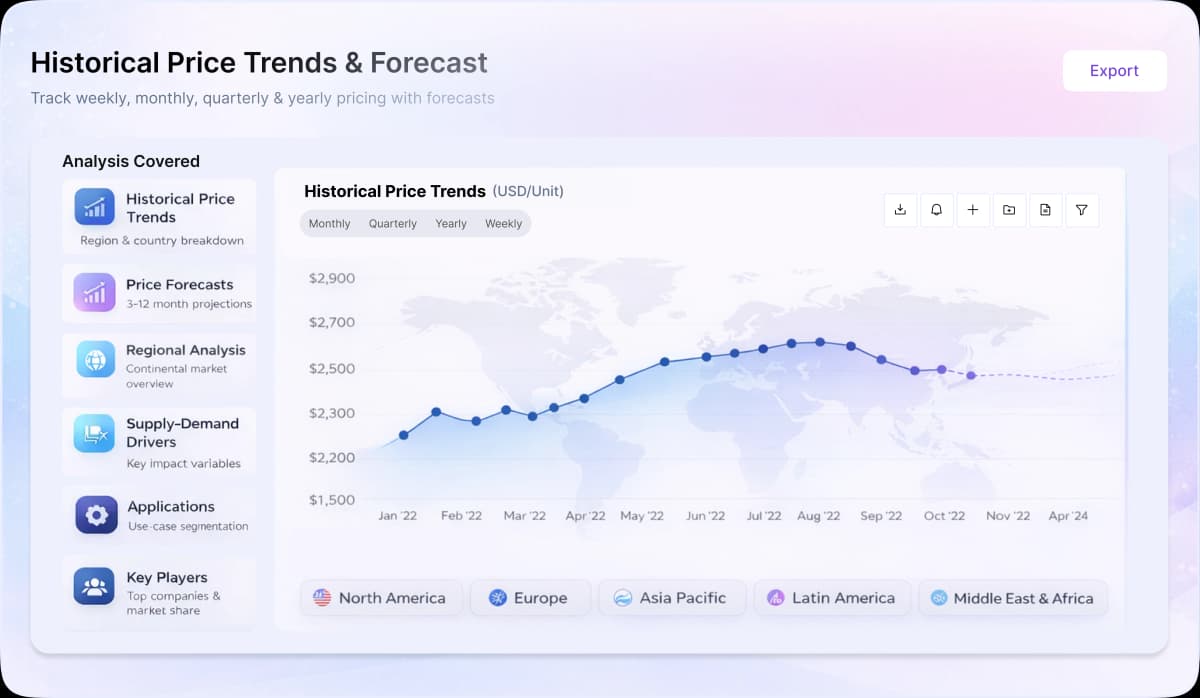
Need latest Polyphenylene Ether prices?
Get real-time price assessments, periodic trends, forecasts and price driver insights across key global markets.
Unlock Price Insights NowOur Clients
Asia
In the first half of 2025, the Polyphenylene Ether (PPE) market in Asia experienced a range of trends. Early in the year, demand from key sectors such as automotive and electronics was weak, contributing to a bearish market. This was primarily due to high inventory levels and a slow recovery from the post-holiday season.
However, as the first quarter progressed, some positive signs emerged. Supply constraints, particularly from scheduled plant shutdowns and logistical disruptions, began to drive prices upward in February.
By March, the market showed noticeable improvement, with industrial activities picking up, especially after the Spring Festival. The automotive sector, in particular, showed signs of recovery, lifting PPE consumption. Despite early-year challenges, the second quarter saw a gradual improvement in demand, supported by renewed production activity and stabilizing supply chains.
Europe
In Europe, the PPE market was marked by volatility in the first half of 2025. The region faced high energy costs and carbon taxes, which exerted upward pressure on prices, even though demand remained relatively muted in the first quarter. Throughout this period, European producers struggled with production costs and overcapacity, which added to the market uncertainty.
The sluggish demand continued, particularly from the automotive and construction sectors, where purchasing activities remained cautious. While production costs were high, there were no significant disruptions in the supply chain, so prices remained relatively stable, but the market remained oversupplied. By the second quarter, demand showed signs of stabilization, but the overall outlook for PPE remained tepid as producers faced ongoing challenges in balancing supply and demand.
North America
In North America, the PPE market experienced a generally subdued trend during the first half of 2025. The year began with some temporary price increases due to cold weather disruptions in production and transportation, but the overall sentiment remained weak. By the second quarter, as temperatures stabilized, the market began to reflect the larger global trend of moderate demand.
The automotive and electronics industries, major consumers of PPE, showed slower recovery than expected, which contributed to subdued purchasing. Throughout this period, inventories built up, and price pressure from high production costs did not result in sustained upward movement. By mid-year, the market showed signs of stabilization, but prices remained relatively flat, reflecting cautious demand and stable supply.
Related Report
Get real-time price assessments, periodic trends, forecasts and price driver insights across key global markets.
Unlock Price Insights NowOur Clients

Turn price intelligence into action with the Procurement Resource Database. Log in or subscribe to unlock live price trends, historical charts, supplier databases, cost curves, and analyst-backed insights across chemicals, agriculture, energy, packaging, and more. Use these tools to benchmark your contracts, plan budgets with confidence, and stay ahead of market moves on every product you buy.

0
+Products
0
+Regions
0
+Subscriptions
Asia
In Q4 ‘24, the Polyphenylene Ether market in Asia, particularly China and surrounding regions, faced mild downward pressure on prices. This was largely due to weak demand from downstream industries such as automotive and electronics. Similar to the phenol market, PPE saw reduced consumption caused by seasonal slowdowns and destocking activity.
Although feedstock supply remained adequate, production rates were lowered to manage excess inventory and weakened export demand. External challenges, such as Typhoon Kong-Rey disrupting logistics and reducing shipments, added further pressure. Despite some support from the cosmetics and coatings sectors in countries like South Korea, the market overall remained subdued, mirroring the performance of related chemicals.
Europe
The European PPE market followed a stable-to-weak trend throughout Q4’24. Demand from sectors like automotive, construction, and electrical components remained soft, which in turn dampened PPE consumption. The phenol market’s sluggishness driven by high inventories, weak demand, and seasonal slowdowns had a ripple effect on PPE, given phenol’s role in its production.
Although production rates were stable, logistical issues, including storm-related rail congestion and tight shipping availability, impacted timely deliveries and added to inventory accumulation. The moderate feedstock availability and stagnant economic conditions contributed to a conservative purchasing approach across the value chain, preventing any significant upward movement in PPE prices.
North America
The PPE market in North America showed signs of stability, with a slightly positive undertone driven by strong demand in specific downstream sectors such as personal care, paints, and coatings. While the phenol market experienced bearish conditions due to oversupply and weak construction and automotive demand, PPE benefited from a more resilient demand base.
Rising interest in eco-friendly applications, including high-performance polymers and coatings, supported prices. However, operating at high production rates remained a challenge amidst feedstock pressure and a cautious demand environment, especially towards the end of the quarter.
Polyphenylene ether is a high performing thermoplastic polymer that has excellent electrical insulating properties, thermal stability, and chemical resistance. It is thus used in the applications that require electrical insulation, heat resistance such as electrical connectors, automotive components, water filtration systems, and various industrial applications. PPE is known for its durability and reliability in harsh environments, making it a valuable material in a wide range of industrial and commercial applications.
C15H11O
Electrical and electronics, Automotive, Water filtration, Medical Devices, Aerospace, Consumer goods, Industrial equipment
Sumitomo Chemical Co Ltd, Tokai Rika Create Corporation, Guangzhou Engineering Plastics Industries Co Ltd, Asahi Kasei Corp., ROMIRA GmbH, Kingfa Science & Technology Limited, Mitsubishi Chemical Corporation, SABIC
CurrencyUS$ (Data can also be provided in local currency)
Supplier Database AvailabilityYes
Customization ScopeThe report can be customized as per the requirements of the customer
Post-Sale Analyst Support360-degree analyst support after report delivery
Note: Our supplier search experts can assist your procurement teams in compiling and validating a list of suppliers indicating they have products, services, and capabilities that meet your company's needs.
Our Price Analysis Methodology

Experience how Procurement Resource transforms raw material price data into clear, decision ready intelligence. Optimise your performance with reliable, expert market data and analysis. Schedule your demo today to experience a live walk-through where our experts will showcase interactive price charts, forecasted prices, and insights driving the prices for your key commodities, tailored to your workflows. Contact us now!
Our Team will be happy to assist you
We are just a text away
Still Need Help ?
The study offers a detailed cost analysis of Polyester (POY) Production via Polymer Melting, Filtration and High-speed Spinning. In addition, the report incorporates the manufacturing process with detailed process and material flow, operating costs along with financial expenses and depreciation charges.
This report presents a detailed cost analysis of carbon fibre production from a polymer using carbonization. Before carbonization, the long strands of fibre are drawn to form a polymer filament yarn.
Unlock full access to Procurement Resource's price databases, interactive charts, and short-term forecasts for thousands of commodities. Elevate your sourcing decisions by comparing prices across regions, downloading historical data, and layering in analyst-backed insights, all with our flexible plans that scale as your portfolio grows.
Still have any Questions
Contact Us


Price Trend Dashboard - What's Included
Price trends across a diverse portfolio of categories and products, spanning board to niche chemicals
Coverage extendable to grade-specific chemicals based on procurement requirements
Regular price tracking supported by robust historical datasets
News, policy updates, and key market drivers impacting price movements
Short-term and long-term price outlooks and forecasts
Supply–demand dynamics and capacity-driven market analysis