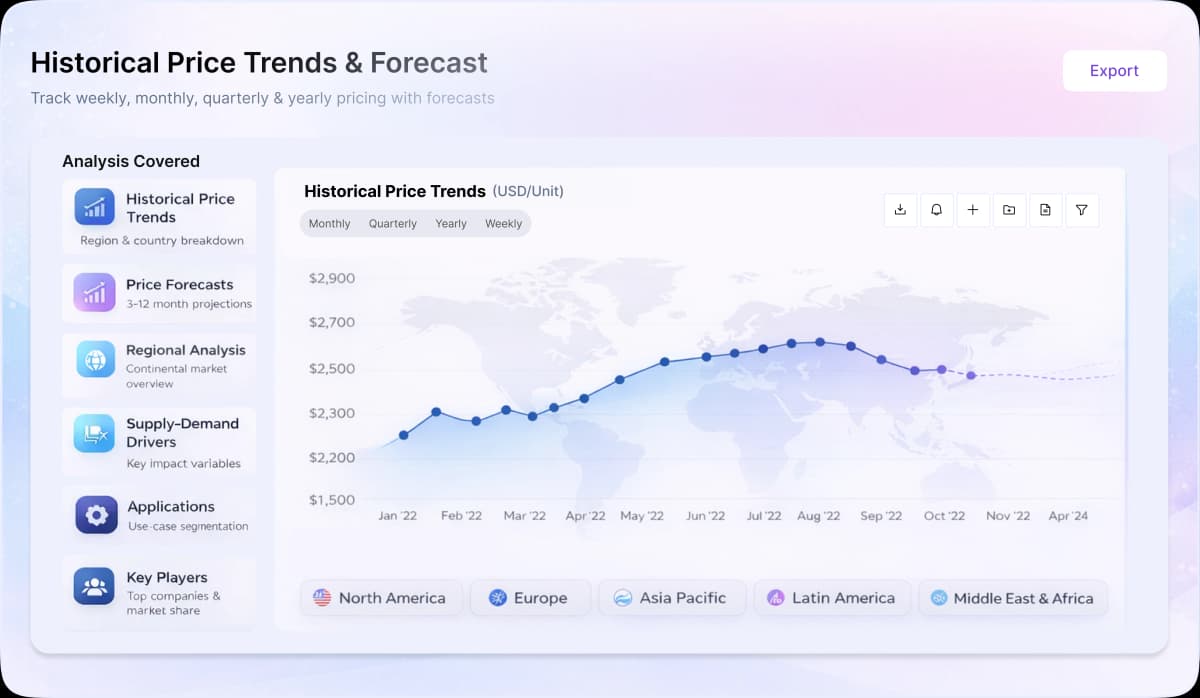
Potassium Carbonate Price Trend Analysis 2026: Price Drivers, Supply Demand Analysis, Historical Prices, Market Insights & Latest News

Udeesha Tomar profile photo
Written ByUdeesha Tomar

Procurement Resource Database

Laptop screen

Turn price intelligence into action with the Procurement Resource Database. Log in or subscribe to unlock live price trends, historical charts, supplier databases, cost curves, and analyst-backed insights across chemicals, agriculture, energy, packaging, and more. Use these tools to benchmark your contracts, plan budgets with confidence, and stay ahead of market moves on every product you buy.

0

+

Products

0

+

Regions

0

+

Subscriptions

Asia

In Asia, the market for this potassium-based chemical remained mostly firm during Q4’25. Demand from agriculture and industrial applications stayed strong, especially in countries with large fertilizer and chemical consumption. Supply was somewhat limited due to logistics constraints and export restrictions, which kept the market supported. Buyers were cautious and purchased only what they immediately needed, which maintained steady activity but prevented sharp price swings. Overall, prices held firm throughout the quarter, supported by the consistent need for fertilizers and industrial feedstocks.

Europe

In Europe, prices were largely stable for most of Q4’25. The market relied heavily on imports from major producing countries, and limited new supply caused minor uncertainty. Environmental regulations and higher production costs prevented local producers from reducing prices significantly. Demand from food processing, industrial, and agricultural sectors remained steady, though buyers were careful and avoided overstocking. Trading activity was moderate, and small fluctuations in supply and demand were absorbed without causing major price changes.

North America

In North America, the market showed stable to slightly soft pricing during Q4’25. Domestic production was limited, and imports from major producers supported the supply. Some anticipation of increased shipments from newly available sources created mild downward pressure toward the end of the quarter. Demand from agriculture and industrial users remained consistent, but buyers stayed cautious and avoided large inventories. While prices stayed mostly steady for much of the quarter, the potential for additional supply kept the market under mild pressure.

About Potassium Carbonate

Potassium carbonate is a dipotassium salt of carbonic acid. It is an odourless deliquescent white powder and is hygroscopic in nature. It dissolves readily in water but is insoluble in alcohol, acetone, and ethanol. It has applications in producing glass, soaps, wire or mead, etc.

Potassium Carbonate Product Detail

HS Code
28364000
Chemical Formula

K2CO3

CAS Number
584-08-7
Molecular Weight
138.205 g/mol
Industrial Uses

Fire retardant, welding fluxes, buffering agent, mild drying agent, glass, soaps

Synonyms

Carbonate of potash, Dipotassium carbonate, Pearl ash

Supplier Database

Evonik Industries AG, UNID GLOBAL Corporation, Oxy (Occidental Petroleum Corporation), Armand products, Vynova Group, AGC Chemicals, Gujarat Alkalies and Chemicals Limited, Altair Chimica

Regional Coverage

Asia Pacific

China, India, Indonesia, Pakistan, Bangladesh, Japan, Philippines, Vietnam, Iran, Thailand, South Korea, Iraq, Saudi Arabia, Malaysia, Nepal, Taiwan, Sri Lanka, UAE, Israel, Hongkong, Singapore, Oman, Kuwait, Qatar, Australia, and New Zealand

Europe

Germany, France, United Kingdom, Italy,Spain, Russia, Turkey, Netherlands, Poland, Sweden, Belgium, Austria, Ireland Switzerland, Norway, Denmark, Romania, Finland, Czech Republic, Portugal and Greece

North America

United States and Canada

Latin America

Brazil, Mexico, Argentina, Columbia, Chile, Ecuador, and Peru

Africa

South Africa, Nigeria, Egypt, Algeria, Morocco

CurrencyUS$ (Data can also be provided in local currency)

Supplier Database AvailabilityYes

Customization ScopeThe report can be customized as per the requirements of the customer

Post-Sale Analyst Support360-degree analyst support after report delivery

Note: Our supplier search experts can assist your procurement teams in compiling and validating a list of suppliers indicating they have products, services, and capabilities that meet your company's needs.

Potassium Carbonate Production Processes

The reaction between potassium hydroxide and carbon dioxide produces potassium carbonate. The reaction results in the formation of hydrated potash, which is further heated to give the hydrated potassium carbonate salt.

Frequently Asked Questions

Potassium carbonate prices are shaped by region-specific supply and demand dynamics. In Asia, logistics constraints and export restrictions limit available supply, keeping prices firm against strong agricultural and industrial demand. In Europe, environmental regulations and elevated production costs prevent local producers from cutting prices, while reliance on imports with limited new supply creates minor uncertainty. In North America, anticipation of increased shipments from newly available sources exerts mild downward pressure, even as consistent agricultural and industrial demand provides underlying support.

Production is concentrated among OxyChem, Zhejiang Juhua, AGC Chemicals, and Armand Products, with UNID Global, Vynova Group, Gujarat Alkalies and Chemicals, and Altair Chimica also active. The critical feedstock potassium chloride comes primarily from Canada, Russia, Belarus, and China, so any disruption there directly impacts potassium carbonate supply. Europe's heavy import reliance and North America's limited domestic production increase vulnerability to supply-chain shifts. Agriculture (fertilizers) and glass manufacturing drive demand across Asia and Europe, with food processing adding steady pull in Europe.

Potassium carbonate is produced via electrolysis of potassium chloride, yielding potassium hydroxide, chlorine and hydrogen. The potassium hydroxide is then reacted with carbon dioxide to form potassium carbonate. The finished product serves glass manufacturing as a flux, the soap and household cleaner industries, fire extinguishers, pharmaceuticals as a drying agent, food and beverage processing including cocoa and wine, and agriculture as a fertilizer. Procurement costs are shaped by potassium chloride and carbon dioxide availability, shipping rates, and seasonal agricultural demand.

Glass manufacturing, soap and detergent production, agriculture, food and beverage processing, and pharmaceuticals are the primary demand drivers for potassium carbonate. Glass and detergent makers consume the largest volumes, while agriculture uses it as a fertilizer input. Strong Asian demand, logistics constraints, and export restrictions keep Asian prices firm. In Europe, steady food processing and agricultural consumption support stable pricing despite import dependency. In North America, consistent industrial and agricultural demand holds prices mostly steady, though new supply expectations can introduce mild downward pressure.

Procurement Resource assesses potassium carbonate price trends through a structured, data driven methodology combining primary engagement with producers, suppliers and traders, secondary market data, monitoring of feedstock and input costs, trade-flow and inventory tracking, and exchange or spot benchmarks. These inputs are validated and translated into a transparent price assessment and outlook. The detailed methodology is available on the Procurement Resource website.

Our Price Analysis Methodology

About the Author

Udeesha Tomar profile photo

Udeesha Tomar

AVP - Strategy and Solutions

Leading procurement research solutions across chemicals, materials, and food & beverages, with expertise in price forecasting and market analytics.

Schedule Demo

Schedule A Demo

Experience how Procurement Resource transforms raw material price data into clear, decision ready intelligence. Optimise your performance with reliable, expert market data and analysis. Schedule your demo today to experience a live walk-through where our experts will showcase interactive price charts, forecasted prices, and insights driving the prices for your key commodities, tailored to your workflows. Contact us now!

Our Team will be happy to assist you

We are just a text away

+1

Still Need Help?

Europe & Africa

+44 7573 171117

[email protected]

USA & Canada

+1 307 363 1045

[email protected]

APAC

+91 8850629517

[email protected]

Unlock full access to Procurement Resource's price databases, interactive charts, and short-term forecasts for thousands of commodities. Elevate your sourcing decisions by comparing prices across regions, downloading historical data, and layering in analyst-backed insights, all with our flexible plans that scale as your portfolio grows.

Still have any Questions

Contact Us
Mastercard
Wire
VISA
Stripe

Why Procurement Database

Commodity Market Intelligence

Commodity Market Intelligence

Track prices, market movements, supply-demand dynamics, and industry developments across hundreds of commodities through a centralized intelligence platform built for informed procurement decisions.

Price Forecasts & Market Outlooks

Price Forecasts & Market Outlooks

Understand market fluctuations using analyst-backed forecasts, historical pricing patterns, and evolving industry trends to strengthen sourcing strategies and budget planning.

Cost & Procurement Optimization

Cost & Procurement Optimization

Leverage cost models, pricing benchmarks, and procurement insights to evaluate purchasing opportunities, improve negotiations, and enhance operational efficiency.

Global & Regional Market Insights

Global & Regional Market Insights

Access region-specific price trends, trade activities, capacity changes, and supply chain developments influencing commodity markets worldwide.

1/4