Need latest Sunflower Oil prices?
Get real-time price assessments, periodic trends, forecasts and price driver insights across key global markets.
Unlock Price Insights NowOur Clients
| Product | Region | Incoterm Basis | Price | Time Period |
| Sunflower Oil | USA | CIF | USD 5393/MT | April 2026 |
| Sunflower Oil | Saudi Arabia | CIF | USD 5315/MT | April 2026 |
| Sunflower Oil | Russia | CIF | USD 5,395/MT | April 2026 |
| Sunflower Oil | China | CIF | USD 5,303/MT | April 2026 |
| Sunflower Oil | Canada | CIF | USD 5,342/MT | April 2026 |
| Sunflower Oil | USA | CIF | USD 5,382.00/MT | March 2026 |
| Sunflower Oil | Saudi Arabia | CIF | USD 5,304.39/MT | March 2026 |
| Sunflower Oil | Russia | CIF | USD 5,383.96/MT | March 2026 |
| Sunflower Oil | China | CIF | USD 5291.63/MT | March 2026 |
| Sunflower Oil | Canada | CIF | USD 5330.78/MT | March 2026 |
Stay updated with the latest Sunflower Oil prices, historical data, and tailored regional analysis
Asia
In Asia, sunflower oil prices remained firm during the first quarter of 2026. The global production of sunflower oil remained at about 20.75 million metric tons in 2025/26, only slightly above 20.38 million metric tons in 2024/25, which kept supply growth limited and supported regional prices. The impact of the war added further pressure, as disruptions to Black Sea trade flows, vessel rerouting, and higher freight and insurance costs slowed deliveries and increased landed costs for Asian buyers. China remained linked to global supply conditions despite domestic production, so tighter export availability continued to influence sentiment. In India, sunflower oil imports are expected to decline because higher prices, slower arrivals, and tighter supply from key exporting origins reduced buying interest. These disruptions also encouraged partial substitution toward palm and soybean oil, which limited stronger demand growth for sunflower oil while keeping domestic prices firm.
Europe
In Europe, the market remained supported as the region continued to be one of the leading producers, with output recovering from the previous low base. However, global trade stayed tight because lower sunflower exports from Ukraine were only partly offset by higher shipments from Russia and Kazakhstan. The Middle Eastern war also increased uncertainty around Black Sea logistics, extended transit risks, and added pressure on regional procurement. As a result, even with better regional production, European buyers continued to face firm supply conditions and elevated replacement costs.
North America
In North America, the market stayed relatively stable, as the region had a smaller role in shaping global sunflower oil trade compared with Europe and the Black Sea market. Still, the effects of the war were visible through tighter global export availability, firmer international prices, and shifting trade patterns. The market was influenced more by these external disruptions than by any major domestic supply shift, which kept sentiment supported.
Analyst Insight
According to Procurement Resource, in the near term, the sunflower oil price trend is expected to remain firm because global production growth is modest, leaving the market susceptible to any further disruption in export flows.
Related Report
Get real-time price assessments, periodic trends, forecasts and price driver insights across key global markets.
Unlock Price Insights NowOur Clients

Turn price intelligence into action with the Procurement Resource Database. Log in or subscribe to unlock live price trends, historical charts, supplier databases, cost curves, and analyst-backed insights across chemicals, agriculture, energy, packaging, and more. Use these tools to benchmark your contracts, plan budgets with confidence, and stay ahead of market moves on every product you buy.

0
+Products
0
+Regions
0
+Subscriptions
Asia
Sunflower oil market in Asia remained firm during Q4’25, primarily driven by elevated import costs and sustained demand across key consuming regions such as India. The market reflected strong pass-through of global supply tightness, with buyers relying heavily on imports from Russia, Ukraine, and Argentina. Despite a significant build-up in edible oil inventories and adequate port stocks, demand momentum ahead of the festive season kept procurement activity stable. Higher freight costs, currency fluctuations, and tight global availability continued to support the bullish undertone, while diversified sourcing strategies helped mitigate supply risks but did not ease overall market firmness.
Europe
The European sunflower oil market experienced a notable upward trajectory in Q4’25, supported by tightening supply fundamentals and adverse crop developments across the region. Production concerns intensified as Ukrainian sunflower crop estimates were repeatedly revised downward due to unfavorable weather conditions, slow harvesting progress, and weaker crop quality. Crushing activity in Ukraine also declined significantly, indicating reduced availability of processed oil in the export market. Additionally, the EU and Turkey reported slightly lower harvests compared to the previous season, further tightening regional supply. Lower beginning stocks and steady import demand added pressure, while farmers in key producing regions held back sales in anticipation of better realizations. These combined factors created a supply-constrained environment, keeping the market sentiment firm throughout the quarter.
North America
In North America, sunflower oil market dynamics in Q4’25 were largely influenced by global trade flows and supply developments in the Black Sea region rather than domestic production shifts. The tightening export availability from Ukraine, coupled with lower output expectations in Europe and Turkey, impacted import parity and procurement strategies. Market participants closely monitored global supply signals, particularly reduced crushing activity and constrained seed availability in key exporting countries. Additionally, logistical considerations and elevated international trade dependencies kept buyers cautious, while the broader vegetable oil complex remained sensitive to shifting global supply-demand balances. The region witnessed stable to firm sentiment as downstream industries adjusted sourcing strategies in response to constrained global supplies.
Sunflower Oil is known as the non-volatile pressed oil that is taken from the seeds of sunflower. Sunflower oil is typically utilised in food as a frying oil, as well as in cosmetic formulations or as an emollient. The world's total manufacturing of sunflower oil in 2014 was nearly 16 million tonnes, with Ukraine and Russia as the largest producers.
Frying oil, Mayonnaise and oil-based dressings Cosmetics, Emollient
Kernel, EFKO Group, ASTON JSC, Cargill Incorporated, Optimus Agro, Bunge Limited, Adams Group
CurrencyUS$ (Data can also be provided in local currency)
Supplier Database AvailabilityYes
Customization ScopeThe report can be customized as per the requirements of the customer
Post-Sale Analyst Support360-degree analyst support after report delivery
Note: Our supplier search experts can assist your procurement teams in compiling and validating a list of suppliers indicating they have products, services, and capabilities that meet your company's needs.
The process involves cleaning and sorting of the sunflower seeds and their grinding. This is followed by pressing and extraction of crude oil from these seeds, where a volatile hydrocarbon such as hexane is utilised as a solvent for oil extraction. The derived oil is further refined before packaging.
Our Price Analysis Methodology

Experience how Procurement Resource transforms raw material price data into clear, decision ready intelligence. Optimise your performance with reliable, expert market data and analysis. Schedule your demo today to experience a live walk-through where our experts will showcase interactive price charts, forecasted prices, and insights driving the prices for your key commodities, tailored to your workflows. Contact us now!
Our Team will be happy to assist you
We are just a text away
Still Need Help ?
This report provides the cost structure of LPG production by the petroleum refining process. In this process, the crude oil recovered is separated into oil and wet gas via a gas trap.
This report provides the cost structure of PET production through esterification of ethylene glycol and terephthalic acid.

Unlock full access to Procurement Resource's price databases, interactive charts, and short-term forecasts for thousands of commodities. Elevate your sourcing decisions by comparing prices across regions, downloading historical data, and layering in analyst-backed insights, all with our flexible plans that scale as your portfolio grows.
Still have any Questions
Contact Us


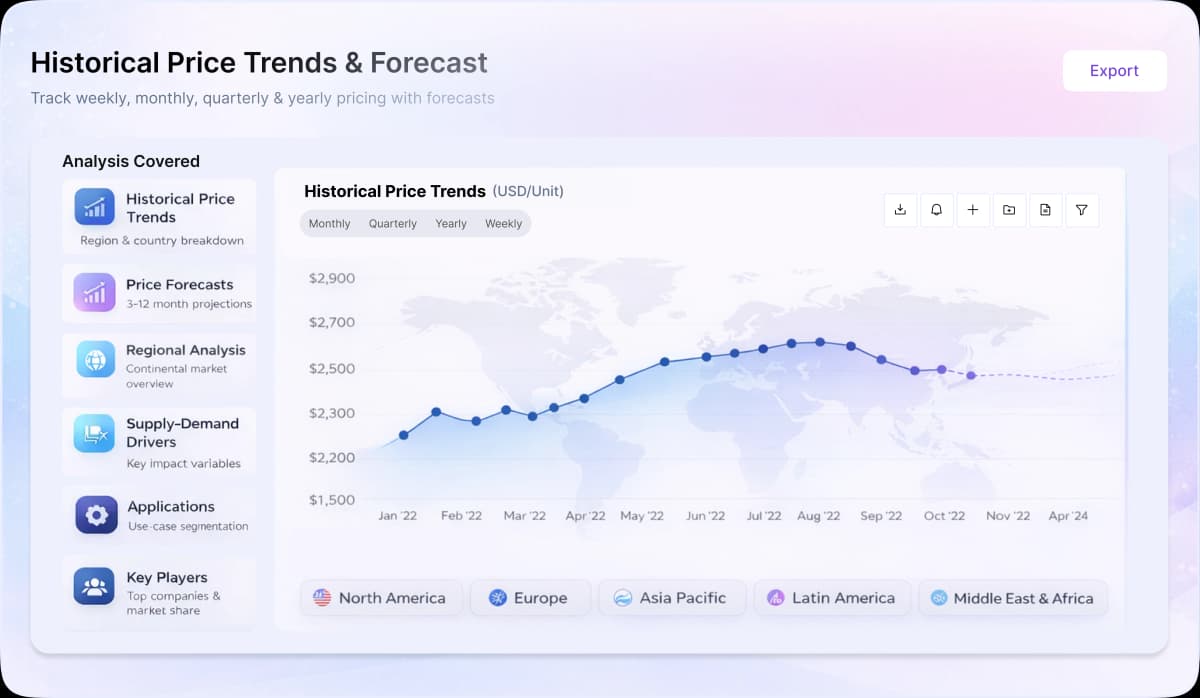
Price Trend Dashboard - What's Included
Price trends across a diverse portfolio of categories and products, spanning board to niche chemicals
Coverage extendable to grade-specific chemicals based on procurement requirements
Regular price tracking supported by robust historical datasets
News, policy updates, and key market drivers impacting price movements
Short-term and long-term price outlooks and forecasts
Supply–demand dynamics and capacity-driven market analysis