
Udeesha Tomar
AVP - Strategy and Solutions
Leading procurement research solutions across chemicals, materials, and food & beverages, with expertise in price forecasting and market analytics.

Asia
In Q1’25, trichloroacetic acid prices in Asia showed a downward trajectory, particularly in China which dominates regional production. The market faced significant pressure from oversupply conditions, with high production capacity utilization across manufacturing facilities. Chinese domestic producers maintained elevated output levels despite weakening demand signals, contributing to inventory buildup.
Export volumes from China increased noticeably as producers sought to alleviate domestic oversupply, with competitive pricing strategies employed to maintain market share. The Lunar New Year period brought temporary disruptions but failed to meaningfully reduce supply pressure. Fluctuations in upstream methanol and chlorine feedstock costs provided some price volatility, with methanol's temporary strengthening in early January briefly supporting prices before resumed decline as feedstock costs weakened later in the quarter.
Europe
European trichloroacetic acid markets experienced more stability compared to Asia during Q1, though prices trended moderately lower. The region remained a net importer, with increased pressure from competitively priced Asian imports affecting domestic producer margins. Manufacturing activity showed sluggish recovery following the winter holiday period, with downstream demand from herbicide and pharmaceutical sectors remaining subdued.
Western European producers operated at reduced capacity rates to maintain market balance, while Eastern European markets saw greater price volatility due to logistical challenges and inconsistent demand patterns. By quarter's end, prices had settled at lower levels compared to Q4’24, though the decline was less severe than in Asian markets.
North America
North American trichloroacetic acid markets demonstrated the greatest resilience among major regions during Q1’25. Prices initially held steady in January before experiencing modest decline through February and March. Regional production remained disciplined, with manufacturers adjusting output to match demand rather than building excess inventory. Downstream sectors, particularly agricultural applications, showed early seasonal purchasing activity by late quarter, providing some demand support.
Import competition pressured domestic producers, though less severely than in Europe due to logistical advantages. Transportation constraints and weather disruptions in certain production regions temporarily tightened supply in specific markets, creating regional price disparities that gradually normalized by quarter's end.
Related Report
Need Latest Trichloroacetic Acid Prices?
Get real-time price assessments, periodic trends, forecasts and price driver insights across key global markets.
Our Clients


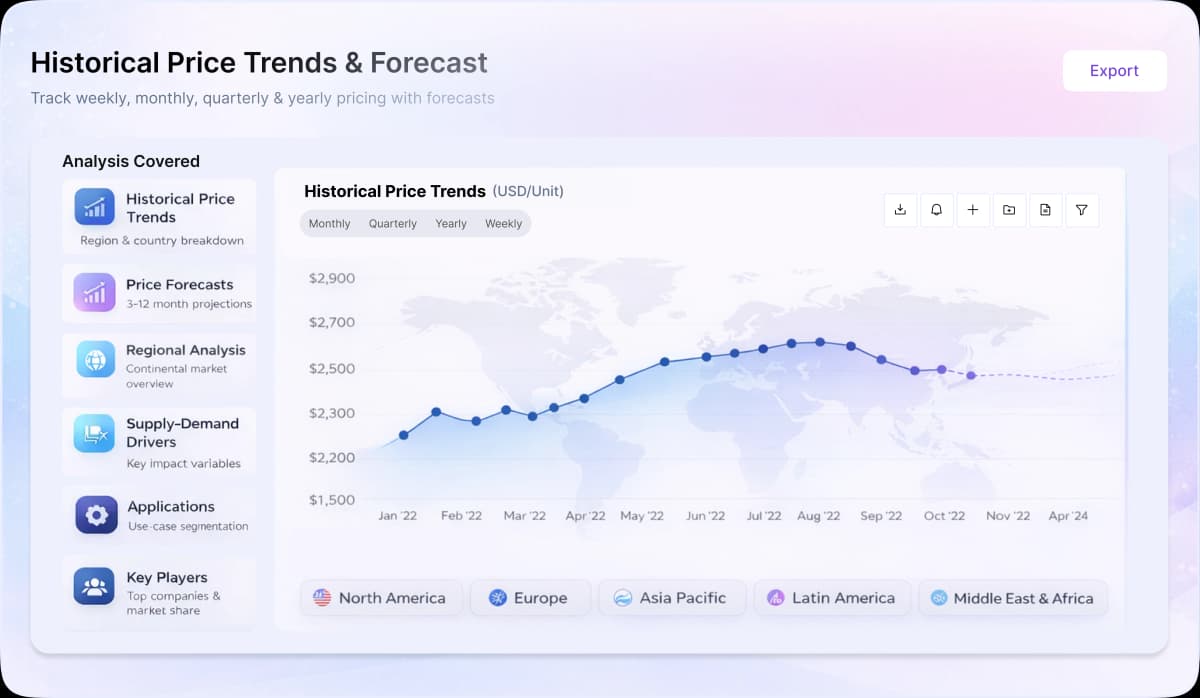
Turn price intelligence into action with the Procurement Resource Database. Log in or subscribe to unlock live price trends, historical charts, supplier databases, cost curves, and analyst-backed insights across chemicals, agriculture, energy, packaging, and more. Use these tools to benchmark your contracts, plan budgets with confidence, and stay ahead of market moves on every product you buy.
0
+Products
0
+Regions
0
+Subscriptions
North America
Throughout 2024, Trichloroacetic Acid (TCA) prices in North America showed a declining trend with notable fluctuations. In Q1, prices initially strengthened due to supply tightness and increased production costs from rising feedstock prices. By Q2, the market witnessed a significant downturn as supply improved while demand from pharmaceuticals and agrochemicals remained subdued.
The summer months saw prices stabilize briefly before declining further in Q3, influenced by weakened industrial activity and lower raw material costs for key precursors. The fourth quarter continued this downward trajectory with prices falling consistently through December, supported by ample supply despite limited downstream demand, particularly from the fertilizer sector.
Asia
The Asian TCA market experienced mixed trends in 2024, with China being the primary influencer. The year began with price strengthening ahead of the Lunar New Year as manufacturers replenished inventories. However, by Q2, prices declined substantially due to oversupply conditions and weak downstream demand. Mid-year brought some stabilization as production capacities were reduced in major manufacturing hubs like Shandong, helping balance supply-demand dynamics. The third quarter saw modest price recovery driven by improved export activity and stabilized domestic consumption. By Q4, though prices declined overall, the rate of decrease slowed considerably, with the market finding support from moderate demand stabilization and reduced production capacity.
Europe
European TCA prices followed a predominantly bearish trend throughout 2024. The first quarter saw an upward movement driven by escalating energy costs and feedstock prices, particularly acetic acid. However, by Q2, prices began declining significantly due to weakening demand from key sectors and ample inventory levels. Summer brought further downward pressure as seasonal agricultural activity decreased, reducing demand from the pesticide sector. The fourth quarter continued this negative trend, with German markets particularly affected as prices declined due to weak pesticide sector demand, lower feedstock costs, and high inventory levels despite rising methanol prices.
Trichloroacetic Acid, a monocarboxylic acid and an organochlorine compound, in its solid form appears as a colourless crystalline substance. It absorbs moisture from air and can form a syrup. It is miscible in water and releases heat upon combining with water. It is derived from acetic acid and is also a conjugate acid of trichloroacetate.
C2HCl3O2 or CCl3COOH
Biochemistry, Solvent, Cosmetic Treatments , Topical Medication, Research Applications
TCA or TCAA, Trichloroethanoic Acid, Aceto-Caustin
Honeywell International Inc, ProChem, Inc. International, Ricca Chemical Company, LLC, MP Biomedicals (Valiant Co., Ltd.), SynQuest Laboratories
CurrencyUS$ (Data can also be provided in local currency)
Supplier Database AvailabilityYes
Customization ScopeThe report can be customized as per the requirements of the customer
Post-Sale Analyst Support360-degree analyst support after report delivery
Note: Our supplier search experts can assist your procurement teams in compiling and validating a list of suppliers indicating they have products, services, and capabilities that meet your company's needs.
Trichloroacetic Acid can be produced using the reaction of chlorine along with acetic acid. This reaction is carried out in the presence of a suitable catalyst, which generates Trichloroacetic Acid as the final product.
Our Price Analysis Methodology
AVP - Strategy and Solutions
Leading procurement research solutions across chemicals, materials, and food & beverages, with expertise in price forecasting and market analytics.

Experience how Procurement Resource transforms raw material price data into clear, decision ready intelligence. Optimise your performance with reliable, expert market data and analysis. Schedule your demo today to experience a live walk-through where our experts will showcase interactive price charts, forecasted prices, and insights driving the prices for your key commodities, tailored to your workflows. Contact us now!
Our Team will be happy to assist you
We are just a text away
Still Need Help?
Milk is acidified using acids like dilute hydrochloric acid or sulfuric acid, until the isoelectric point of casein is achieved.
The report is a detailed study of economics of production of oxalic acid by the reaction of nitric acid with glucose/ sugar.
This report revolves around the production of acetic acid using butane. Butane is oxidized using air as an oxygen source in the presence of metal catalysts such as cobalt acetate, at a temperature of 110–120 °C and a pressure of 60 atm.
Unlock full access to Procurement Resource's price databases, interactive charts, and short-term forecasts for thousands of commodities. Elevate your sourcing decisions by comparing prices across regions, downloading historical data, and layering in analyst-backed insights, all with our flexible plans that scale as your portfolio grows.
Still have any Questions
Contact Us



Price Trend Dashboard - What's Included
Price trends across a diverse portfolio of categories and products, spanning board to niche chemicals
Coverage extendable to grade-specific chemicals based on procurement requirements
Regular price tracking supported by robust historical datasets
News, policy updates, and key market drivers impacting price movements
Short-term and long-term price outlooks and forecasts
Supply–demand dynamics and capacity-driven market analysis

Track prices, market movements, supply-demand dynamics, and industry developments across hundreds of commodities through a centralized intelligence platform built for informed procurement decisions.

Understand market fluctuations using analyst-backed forecasts, historical pricing patterns, and evolving industry trends to strengthen sourcing strategies and budget planning.

Leverage cost models, pricing benchmarks, and procurement insights to evaluate purchasing opportunities, improve negotiations, and enhance operational efficiency.
Access region-specific price trends, trade activities, capacity changes, and supply chain developments influencing commodity markets worldwide.