Udeesha Tomar
AVP - Strategy and Solutions
Leading procurement research solutions across chemicals, materials, and food & beverages, with expertise in price forecasting and market analytics.
| Product | Region | Incoterm Basis | Price | Last Updated Month |
| Calcium Carbonate | China | FOB | USD 317.10/MT | April 2026 |
| Calcium Carbonate | India | FOB | USD 372.10/MT | April 2026 |
| Calcium Carbonate | USA | FOB | USD 404.10/MT | April 2026 |
| Calcium Carbonate | Brazil | FOB | USD 438.20/MT | April 2026 |
| Calcium Carbonate | Canada | FOB | USD 414.10/MT | April 2026 |
| Calcium Carbonate | China | FOB | USD 317.10/MT | April 2026 |
| Calcium Carbonate | India | FOB | USD 372.10/MT | April 2026 |
| Calcium Carbonate | USA | FOB | USD 404.10/MT | April 2026 |
| Calcium Carbonate | Brazil | FOB | USD 438.20/MT | April 2026 |
| Calcium Carbonate | Canada | FOB | USD 414.10/MT | April 2026 |
Stay updated with the latest Calcium Carbonate prices, historical data, and tailored regional analysis
Asia
In Asia, the calcium carbonate market showed mixed behaviour, with China experiencing downward pressure due to oversupply and cautious downstream procurement. Post-production inventory build-up and weak buying interest from plastics, paper, and food sectors led to softer pricing trends, while limited export competitiveness restricted inventory clearance. At the same time, feedstock conditions remained stable, with world lime production at about 420,000 thousand metric tons in 2025 and China contributing around 310,000 thousand metric tons, indicating no major raw material disruption. However, war-related logistics issues, including higher freight costs and shipment delays, increased landed costs and prevented sharper price declines. In India, the market remained relatively steady, supported by consistent demand from construction, packaging, and food-grade applications, although higher logistics costs and import dependency kept procurement cautious and prices firm.
Europe
In Europe, calcium carbonate prices remained stable, supported by balanced supply and steady demand from paper, coatings, plastics, and food processing sectors. Sufficient domestic production and controlled output levels prevented supply imbalances, while inland logistics improvements offset port congestion. However, elevated freight costs and ongoing geopolitical disruptions increased replacement costs, reinforcing price stability.
North America
In North America, prices showed a firm trend toward the end of the quarter, supported by tighter domestic availability and elevated logistics costs. Limited import arrivals and higher freight expenses reduced spot flexibility, while steady downstream industrial consumption prevented inventory accumulation. Rising upstream costs and stronger export values further supported supplier pricing confidence.
Analyst Insight
According to Procurement Resource, in the near term, calcium carbonate prices are expected to remain stable to firm, as steady feedstock availability along with persistent logistics disruptions continue to pressurize the market.
Related Report
Get real-time price assessments, periodic trends, forecasts and price driver insights across key global markets.
Unlock Price Insights NowOur Clients

Turn price intelligence into action with the Procurement Resource Database. Log in or subscribe to unlock live price trends, historical charts, supplier databases, cost curves, and analyst-backed insights across chemicals, agriculture, energy, packaging, and more. Use these tools to benchmark your contracts, plan budgets with confidence, and stay ahead of market moves on every product you buy.

0
+Products
0
+Regions
0
+Subscriptions
Asia
In Asia, the prices of calcium carbonate were slightly higher in Q4’25. The prices were supported by tighter inventories and stable downstream demand from the packaging, coatings, and glove industries. However, the construction-related demand was weaker, which prevented the prices from going higher. The producers operated at a normal rate, which ensured that the supply was stable. As a result, the spot prices were range-bound, with buyers buying cautiously. The costs were stable, which prevented the prices from going higher. As a result, the Asian markets were characterized by a balanced tone.
Europe
In the European market, prices of calcium carbonate registered an increase during the quarter. Domestic demand was steady, with industrial and construction-linked consumption supporting the trend. The export pattern resulted in an increase in coastal inventory levels. The industry was operating at regular capacities, and limestone supply was abundant, thereby supporting prices. The prices were steady, with minimal impact of energy and logistics costs. The overall buying pattern was routine, with no indication of inventory restocking. The spot and contract market was firm, with prices registering a gradual increase.
North America
In North America, changes in the prices of calcium carbonate were more significant in Q4’25. At the beginning of the quarter, restocking and strong demand in the food, nutraceuticals, and pharmaceutical industries led to higher prices. Spot prices were also affected, rising as inventories fell, and producers faced increasing energy and logistics costs, resulting in a mild squeeze on their margins. Towards the end of the quarter, natural demand patterns slowed, resulting in a moderate impact on prices.
Calcium carbonate makes up more than 4% of the earth's crust and can be found all over the world. Its most commonly found forms are chalk, limestone, and marble, which are formed over millions of years by the sedimentation of the shells of small, fossilised snails, shellfish, and coral. Although all three forms are chemically identical, they differ in many ways, including purity, whiteness, thickness, and homogeneity. One of the most useful and versatile materials known to man is calcium carbonate.
CaCO3
Construction, Acid Water Treatment, Sugar Processing, Agriculture, Paper Industry, Plastic Industry, Ceramic Industry
Mexican Onyx, Chalk, Onyx Marble, Iceland Spar, Calcite, Limestone
BASF SE, Gulf Cryo, Linde, Praxair Technology Inc., SINOPEC, Chengdu Xinju Chemical Co. Ltd.
CurrencyUS$ (Data can also be provided in local currency)
Supplier Database AvailabilityYes
Customization ScopeThe report can be customized as per the requirements of the customer
Post-Sale Analyst Support360-degree analyst support after report delivery
Note: Our supplier search experts can assist your procurement teams in compiling and validating a list of suppliers indicating they have products, services, and capabilities that meet your company's needs.
Calcium hydroxide is generated when water is added to calcium oxide in the quick lime process, and the required calcium carbonate is then produced by passing carbon dioxide through the solution.
Udeesha Tomar
AVP - Strategy and Solutions
Leading procurement research solutions across chemicals, materials, and food & beverages, with expertise in price forecasting and market analytics.
Our Price Analysis Methodology

Experience how Procurement Resource transforms raw material price data into clear, decision ready intelligence. Optimise your performance with reliable, expert market data and analysis. Schedule your demo today to experience a live walk-through where our experts will showcase interactive price charts, forecasted prices, and insights driving the prices for your key commodities, tailored to your workflows. Contact us now!

Our Team will be happy to assist you
We are just a text away
Still Need Help?
The report is a detailed study of economics of production of calcium sulfate from gypsum which is extracted from the earth by mining.
The report involves the cost analysis of production of calcium carbide in an electric arc furnace from a mixture of lime and coke at approximately 2,200 °C.
The report involves the cost analysis of production of Calcium carbonate from quicklime or calcium oxide.

Unlock full access to Procurement Resource's price databases, interactive charts, and short-term forecasts for thousands of commodities. Elevate your sourcing decisions by comparing prices across regions, downloading historical data, and layering in analyst-backed insights, all with our flexible plans that scale as your portfolio grows.
Still have any Questions
Contact Us


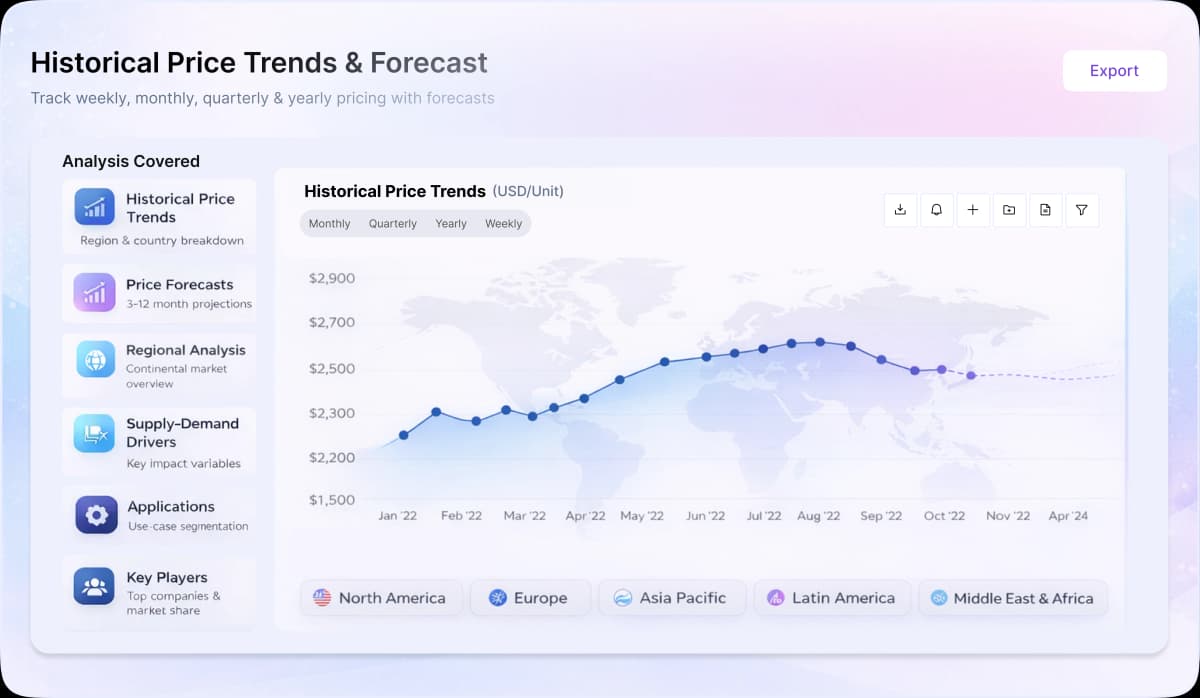
Price Trend Dashboard - What's Included
Price trends across a diverse portfolio of categories and products, spanning board to niche chemicals
Coverage extendable to grade-specific chemicals based on procurement requirements
Regular price tracking supported by robust historical datasets
News, policy updates, and key market drivers impacting price movements
Short-term and long-term price outlooks and forecasts
Supply-demand dynamics and capacity-driven market analysis