Need latest Epichlorohydrin prices?
Get real-time price assessments, periodic trends, forecasts and price driver insights across key global markets.

Unlock Price Insights NowOur Clients
| Product | Region | Incoterm Basis | Price | Last Updated Month |
|---|---|---|---|---|
| Epichlorohydrin | China | FOB | USD 1,930.08/MT | April 2026 |
| Epichlorohydrin | USA | CIF | USD 2,017.08/MT | April 2026 |
| Epichlorohydrin | Germany | CIF | USD 2,056.36/MT | April 2026 |
| Epichlorohydrin | India | CIF | USD 1,979.96/MT | April 2026 |
| Epichlorohydrin | Japan | CIF | USD 1,972.03/MT | April 2026 |
| Epichlorohydrin | China | FOB | USD 1,958.82/MT | March 2026 |
| Epichlorohydrin | China | FOB | USD 1,756.00/MT | February 2026 |
| Epichlorohydrin | USA | CIF | USD 1,854.00/MT | February 2026 |
| Epichlorohydrin | Germany | CIF | USD 1,864.00/MT | February 2026 |
| Epichlorohydrin | India | CIF | USD 1,876.00/MT | February 2026 |
| Epichlorohydrin | Japan | CIF | USD 1,780.00/MT | February 2026 |
Stay updated with the latest Epichlorohydrin prices, historical data, and tailored regional analysis
Asia
In the first half of 2025, Epichlorohydrin prices in Asia showed mixed movement. Early in Q1, prices rose slightly due to higher raw material costs and pre-Lunar New Year restocking. However, the price trend quickly turned downward by mid-January as trade slowed during the holiday period. February saw low demand, especially from epoxy resin and construction sectors, which kept the market soft.
In March, trade tensions and new tariffs on Chinese products led buyers to switch to suppliers in South Korea, boosting demand and causing a mild price recovery. Despite this late upswing, overall market activity stayed cautious in Q2. Limited growth in construction and slow economic momentum kept prices from rising further, though the region saw stable supply.
Europe
Epichlorohydrin prices in Europe steadily declined in H1’25. January started weak as demand remained low, especially in Germany’s construction and coatings industries. Even with rising feedstock costs and some logistical delays, the market stayed oversupplied.
February brought minimal change, with weak epoxy resin demand linked to a slowdown in Asia and soft downstream consumption across Europe. In March, although supply tightened slightly, demand was too sluggish to impact prices. Q2 continued this weak pattern, with economic challenges and high interest rates keeping buyers conservative, despite some supply-side constraints.
North America
In North America, Epichlorohydrin prices fell sharply during H1’25. The first quarter saw a clear downward trend driven by low demand from the epoxy resin sector, which restarted slowly after the winter break. Construction activity remained weak due to economic uncertainty and high mortgage rates.
Although supply conditions eased thanks to better shipping and new capacities in Asia, demand was too soft to support prices. By March, concerns over new tariffs led to a short-term price rebound, but this was not enough to reverse the earlier decline. Q2 saw continued softness, with only modest improvements in demand.
Analyst Insight
According to Procurement Resource, the market sentiment in the coming months will depend on global trade policy shifts and construction sector recovery. Demand remains key to any meaningful price improvement.
Related Report
Get real-time price assessments, periodic trends, forecasts and price driver insights across key global markets.
Unlock Price Insights NowOur Clients

Turn price intelligence into action with the Procurement Resource Database. Log in or subscribe to unlock live price trends, historical charts, supplier databases, cost curves, and analyst-backed insights across chemicals, agriculture, energy, packaging, and more. Use these tools to benchmark your contracts, plan budgets with confidence, and stay ahead of market moves on every product you buy.

0
+Products
0
+Regions
0
+Subscriptions
Asia
In Asia, Epichlorohydrin prices experienced notable volatility during Q4’24. Early in the quarter, the market saw an uptick in prices due to supply disruptions, especially from key producers in China. Scheduled maintenance shutdowns at major plants, along with the impact of a typhoon, tightened the supply situation significantly. This led to price hikes, particularly in November. Furthermore, the imposition of anti-dumping duties by India on imports from China, South Korea, and Thailand further added upward pressure on prices in the region.
Despite these constraints, by the end of November, the market became more cautious as demand softened, resulting in a decline in trading volumes. Downstream demand, particularly from the construction sector, showed signs of recovery, but this did not fully offset the negative impact of high prices. In contrast, a drop in feedstock propylene prices during the period slightly eased production costs but failed to counteract the higher costs triggered by supply constraints.
Europe
In Europe, the Epichlorohydrin market faced a different set of challenges. While the Asian market experienced tightness, Europe struggled with competitive pricing pressures. Despite higher global demand for Epichlorohydrin, the European market saw some price reductions. This was partly due to the softer demand from key downstream industries such as automotive and construction, where consumption slowed as the year drew to a close. Additionally, the market faced competition from other regions, particularly Asia, where lower costs allowed for more competitive pricing. While supply disruptions in Asia did cause some shifts in the global market, the European market remained relatively stable, with no significant price surges.
North America
In North America, Epichlorohydrin prices followed a trend of moderate fluctuations. The region experienced some supply tightening due to global factors, but domestic production levels remained steady. Price adjustments in the region were influenced by the availability of both local and imported materials. Feedstock prices, such as for propylene, had an impact on production costs, but the influence was less pronounced compared to Asia. The downstream demand in North America was somewhat steady, driven by industries like automotive and construction, although the overall market sentiment remained cautious. By the end of the quarter, there was no major shift in pricing, and prices largely held steady despite fluctuations in global market conditions.
Epichlorohydrin is considered an epoxide in which chlorine replaces one of the methyl hydrogens. It is both an epoxide and an organochlorine chemical. Epichlorohydrin is a chlorinated cyclic ether that is volatile and combustible, transparent, colourless, and liquid. When heated to the point of disintegration, it releases hazardous vapours of hydrochloric acid and other chlorinated chemicals. Elastomers, synthetic glycerin, and epoxy resins are all made using epichlorohydrin.
C3H5ClO
Coatings and Adhesives, Production of epoxy resins, Plastics Industry, Production of inks and dyes, Pharmaceuticals
1-Chloro-2,3-epoxypropane
Solvay S.A. Chemicals Company, Zachem SA, Samsung Fine Chemicals Company Limited, Dow Chemical Company, Sumitomo Chemical Company, Aditya Birla Chemicals
CurrencyUS$ (Data can also be provided in local currency)
Supplier Database AvailabilityYes
Customization ScopeThe report can be customized as per the requirements of the customer
Post-Sale Analyst Support360-degree analyst support after report delivery
Note: Our supplier search experts can assist your procurement teams in compiling and validating a list of suppliers indicating they have products, services, and capabilities that meet your company's needs.
Epichlorohydrin is commercially produced by high temperature chlorination of propylene to allyl chloride, followed by hypochlorous acid chlorohydration to form isomeric glycerol dichlorohydrins. The mixture is then dehydrochlorinated with alkali to produce epichlorohydrin.
Our Price Analysis Methodology

Experience how Procurement Resource transforms raw material price data into clear, decision ready intelligence. Optimise your performance with reliable, expert market data and analysis. Schedule your demo today to experience a live walk-through where our experts will showcase interactive price charts, forecasted prices, and insights driving the prices for your key commodities, tailored to your workflows. Contact us now!
Our Team will be happy to assist you
We are just a text away
Still Need Help ?
This report shows the cost structure of glycerin production from the method called epichlorohydrin method.
Unlock full access to Procurement Resource's price databases, interactive charts, and short-term forecasts for thousands of commodities. Elevate your sourcing decisions by comparing prices across regions, downloading historical data, and layering in analyst-backed insights, all with our flexible plans that scale as your portfolio grows.
Still have any Questions
Contact Us


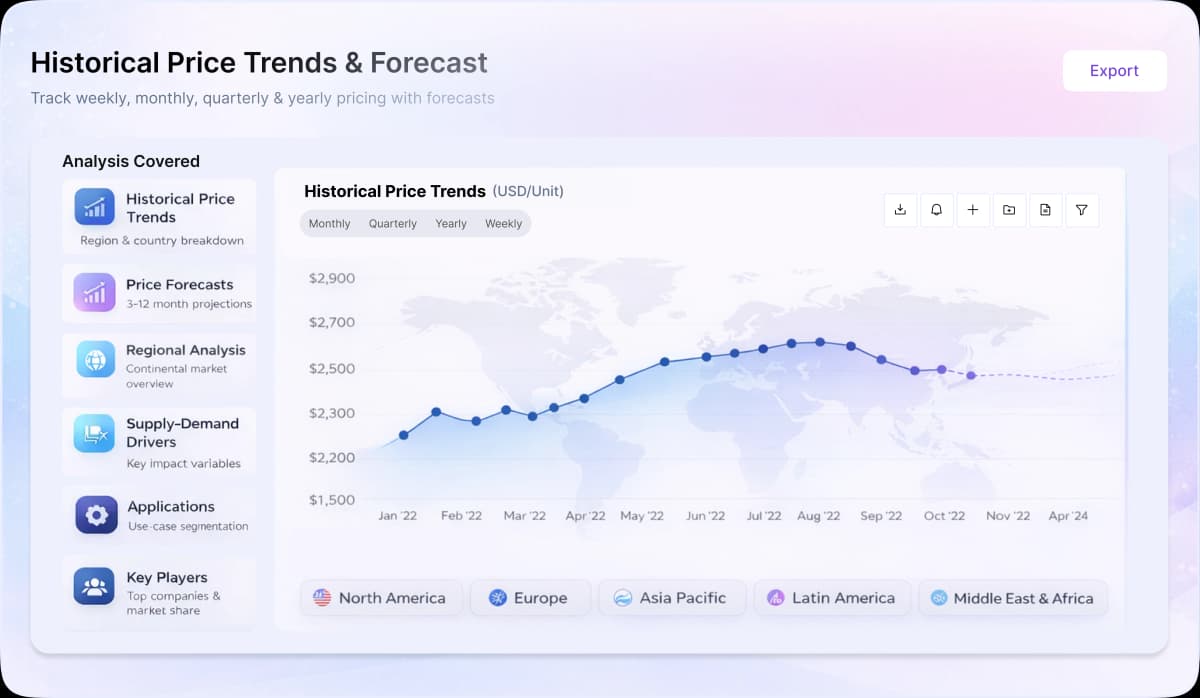
Price Trend Dashboard - What's Included
Price trends across a diverse portfolio of categories and products, spanning board to niche chemicals
Coverage extendable to grade-specific chemicals based on procurement requirements
Regular price tracking supported by robust historical datasets
News, policy updates, and key market drivers impacting price movements
Short-term and long-term price outlooks and forecasts
Supply–demand dynamics and capacity-driven market analysis