Nylon 6 yarn prices hold steady
Nylon 6 yarn price movements stayed within a 0.5% band, indicating a balanced market. Caprolactam feedstock costs stopped falling, removing downward pressure. Direction: stable range-bound.

Nylon 6 yarn price movements stayed within a 0.5% band, indicating a balanced market. Caprolactam feedstock costs stopped falling, removing downward pressure. Direction: stable range-bound.
The IEA expects world oil demand to decline year-on-year for the first time since 2020, driven by the Iran war and Strait of Hormuz closure. Prices have eased on prospects of a surplus late in 2026, but renewed hostilities threaten supplies and introduce volatility.
| Product | Region | Incoterm Basis | Price | Last Updated Month |
|---|---|---|---|---|
| Nylon | China | FOB | USD 2,412.62/MT | August 2026 |
| Nylon | India | CIF | USD 2,504.00/MT | August 2026 |
| Nylon | USA | CIF | USD 2,569.00/MT | August 2026 |
| Nylon | Brazil | CIF | USD 2,555.00/MT | August 2026 |
| Nylon | Canada | CIF | USD 2,613.00/MT | August 2026 |
| Nylon | China | FOB | USD 2,343.16/MT | July 2026 |
| Nylon | India | CIF | USD 2,450.00/MT | July 2026 |
| Nylon | USA | CIF | USD 2,530.00/MT | July 2026 |
| Nylon | Brazil | CIF | USD 2,515.00/MT | July 2026 |
| Nylon | Canada | CIF | USD 2,543.00/MT | July 2026 |
Stay updated with the latest Nylon prices, historical data, and tailored regional analysis
In China, Nylon prices were ~RMB 17.89/kg in April and ~RMB 17.05/kg in May, showing a ~4.7% decrease. The decline was mainly driven by weaker PA6 and PA66 feedstock support after caprolactam, adipic acid, benzene, and HMDA pressure eased. China’s nylon market also faced high producer inventories and need-based buying from textiles, chemical fibers, and modified plastics. Demand was not absent, as May industrial output rose 4.5% year-on-year and automobile manufacturing grew 8.3%, but motor vehicle output fell 3.2%, limiting stronger restocking from engineering plastics and automotive parts. In the United States, Nylon prices were ~USD 2,707.00/MT in April and ~USD 2,639.19/MT in May, showing a ~2.5% decrease. The fall reflected softer global feedstock signals and moderate industrial buying, even though auto demand remained supportive, with June new-vehicle sales estimated at 1.36 million units, up 7.2% year-on-year. Western producers still tried to protect margins through price hikes, citing input availability and value-chain volatility, but weak Asian cost signals and selective downstream procurement capped the market.
Analyst Insight
According to Procurement Resource, in the near term, nylon prices may stay under pressure if feedstocks remain soft, while automotive demand and PA66 supply-risk concerns could limit deeper declines.
Related Report
Need Latest Nylon Prices?
Get real-time price assessments, periodic trends, forecasts and price driver insights across key global markets.
Our Clients


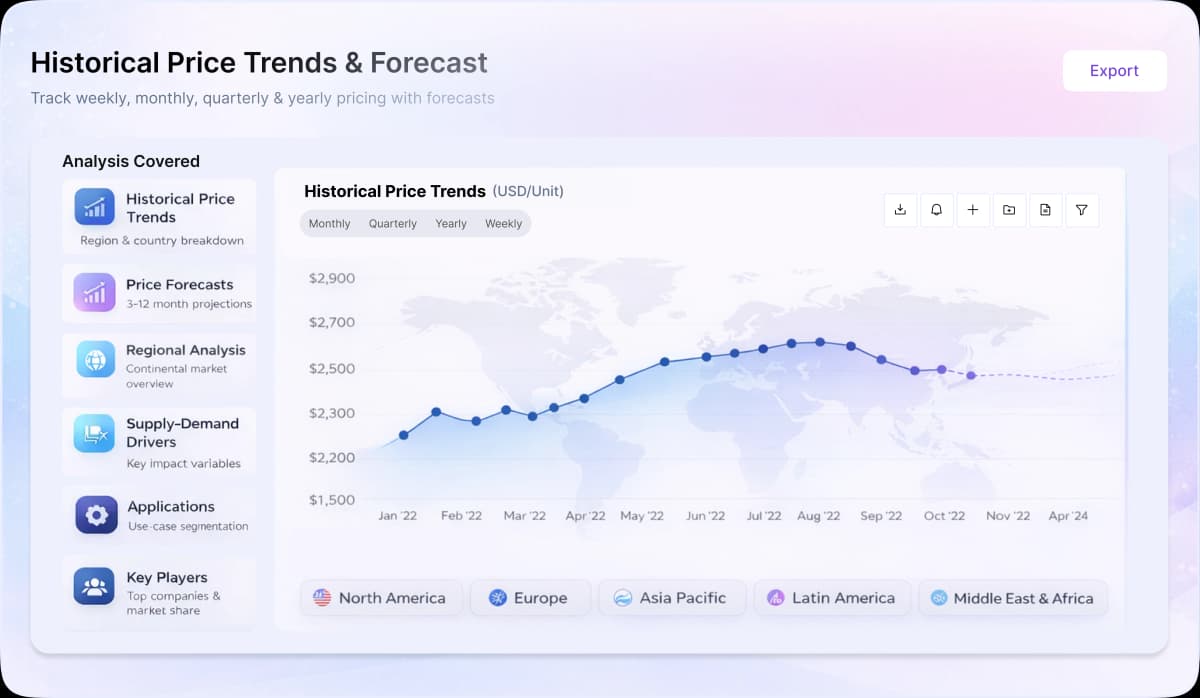
Turn price intelligence into action with the Procurement Resource Database. Log in or subscribe to unlock live price trends, historical charts, supplier databases, cost curves, and analyst-backed insights across chemicals, agriculture, energy, packaging, and more. Use these tools to benchmark your contracts, plan budgets with confidence, and stay ahead of market moves on every product you buy.
0
+Products
0
+Regions
0
+Subscriptions
In China, nylon (polyamide filament) prices moved from weak to strong across Q1’26, driven mainly by feedstock dynamics and subdued demand. In January, prices remained low and stable due to ample caprolactam supply and high domestic self-sufficiency, which reduced import dependence and kept cost support limited. Stable operating rates ensured sufficient supply, while rising inventories reflected oversupply conditions. Downstream demand remained weak due to the seasonal slowdown in the textile and apparel sectors, with procurement limited to essential needs. In February, prices increased as caprolactam costs strengthened amid tighter supply, leading to cost pass-through despite sluggish trading activity and cautious downstream buying. Demand improved slightly with post-holiday restocking and stable export orders, but remained insufficient to drive strong momentum. In March, prices surged sharply due to significant feedstock cost escalation, forcing producers to raise quotations; however, weak downstream demand and resistance to high prices led to reduced procurement and a slight correction toward the end of the month.
Nylon is used to refer to a family of synthetic polymers. It is a thermoplastic silky material that can be drawn, cast, or extruded using spinnerets from a solution (melt) into fibres, films, bristles, or sheets.
Nylon is composed of polyamides, that is, repeating units connected by amide links. It is generally manufactured into yarn, and fabric and can also be processed into moulded products. Nylon is known for its properties like high resistance to wear, chemicals, and heat.
C6H9NO
Polymers, Nylon fibres, Moulds and resins, Food packaging, Filaments , Powder coating, Instrument strings
Policapran, Polycaproamide, Polycaprolactam, Alkamid, Bonamid
AdvanSix , DuPont de Nemours, Inc, Ascend Performance Materials, Honeywell International Inc, BASF SE, INVISTA, GSFC Ltd, Shibaam Polymers, Apex Polymers
CurrencyUS$ (Data can also be provided in local currency)
Supplier Database AvailabilityYes
Customization ScopeThe report can be customized as per the requirements of the customer
Post-Sale Analyst Support360-degree analyst support after report delivery
Note: Our supplier search experts can assist your procurement teams in compiling and validating a list of suppliers indicating they have products, services, and capabilities that meet your company's needs.
Nylon is manufactured by adding adipic acid, hexamethylene diamine and water together in a reaction vessel to obtain Hexamethylene diammonium adipate commonly termed as nylon salt solution. The solution is evaporated and treated to deluster the fibers. After polymeristaion, it is extruded and formed into pellets.
Our Price Analysis Methodology

Business Insights Analyst
Helping procurement and sourcing teams navigate complex markets through data-driven research, category intelligence, and actionable insights - with a focus on identifying market trends, analyzing supply-side developments, and delivering clear intelligence that supports informed business decisions.

Experience how Procurement Resource transforms raw material price data into clear, decision ready intelligence. Optimise your performance with reliable, expert market data and analysis. Schedule your demo today to experience a live walk-through where our experts will showcase interactive price charts, forecasted prices, and insights driving the prices for your key commodities, tailored to your workflows. Contact us now!
Our Team will be happy to assist you
We are just a text away
Still Need Help?
Unlock full access to Procurement Resource's price databases, interactive charts, and short-term forecasts for thousands of commodities. Elevate your sourcing decisions by comparing prices across regions, downloading historical data, and layering in analyst-backed insights, all with our flexible plans that scale as your portfolio grows.
Still have any Questions
Contact Us



Price Trend Dashboard - What's Included
Price trends across a diverse portfolio of categories and products, spanning board to niche chemicals
Coverage extendable to grade-specific chemicals based on procurement requirements
Regular price tracking supported by robust historical datasets
News, policy updates, and key market drivers impacting price movements
Short-term and long-term price outlooks and forecasts
Supply–demand dynamics and capacity-driven market analysis

Track prices, market movements, supply-demand dynamics, and industry developments across hundreds of commodities through a centralized intelligence platform built for informed procurement decisions.

Understand market fluctuations using analyst-backed forecasts, historical pricing patterns, and evolving industry trends to strengthen sourcing strategies and budget planning.

Leverage cost models, pricing benchmarks, and procurement insights to evaluate purchasing opportunities, improve negotiations, and enhance operational efficiency.
Access region-specific price trends, trade activities, capacity changes, and supply chain developments influencing commodity markets worldwide.
